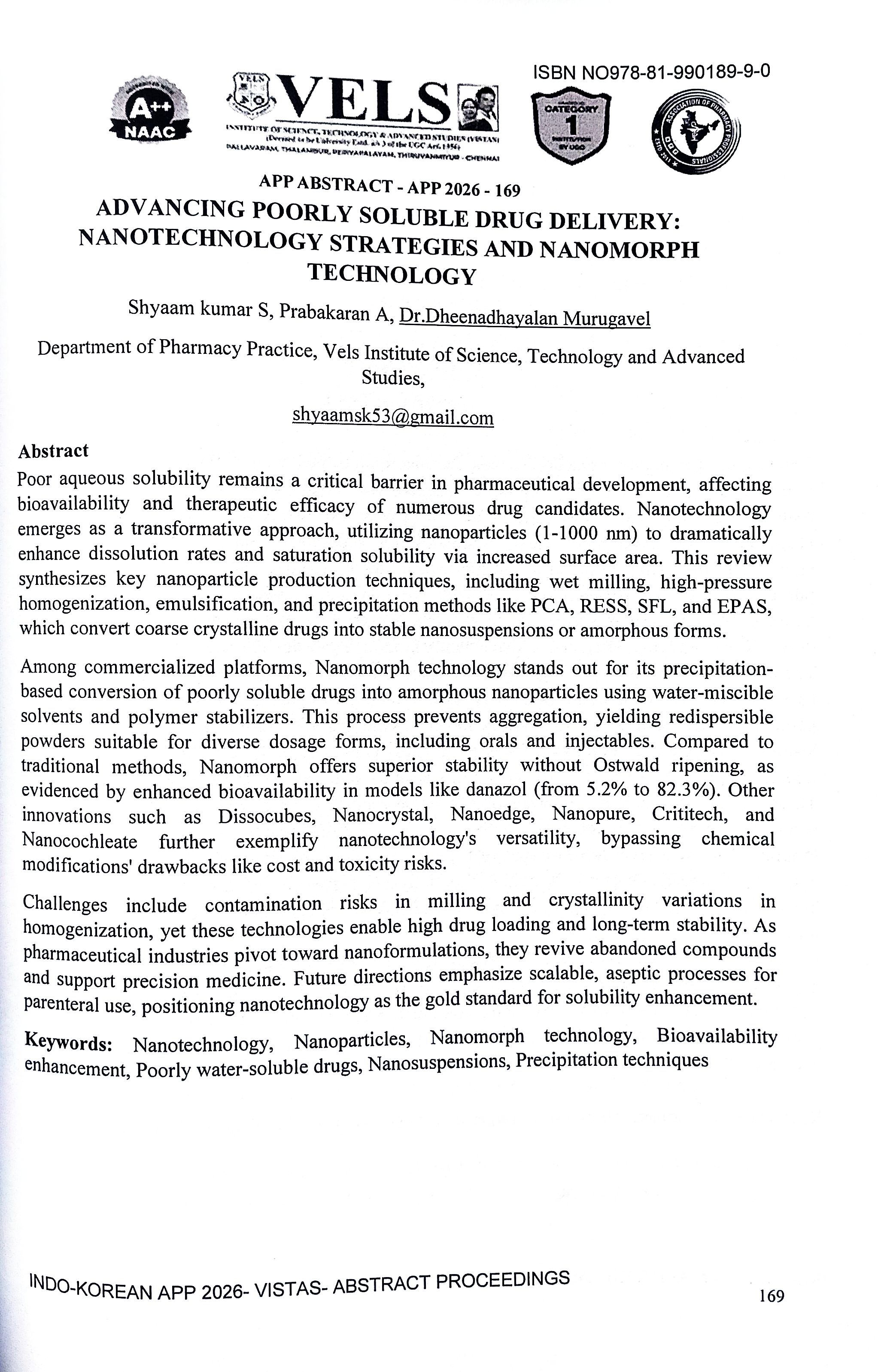
ADVANCING POORLY SOLUBLE DRUG DELIVERY: NANOTECHNOLOGY STRATEGIES AND NANOMORPH TECHNOLOGY
Dheenadhayalan, Murugavel and Shyaam Kumar, S and Prabakaran, A (2026) ADVANCING POORLY SOLUBLE DRUG DELIVERY: NANOTECHNOLOGY STRATEGIES AND NANOMORPH TECHNOLOGY. In: APP INDO-KOREAN INTERNATIONAL CONFERENCE.
![[thumbnail of APP Mar 2026 proceedings_3.jpg]](https://ir.vistas.ac.in/19412/1/APP%20Mar%202026%20proceedings_3.jpg) Image
Image
APP Mar 2026 proceedings_3.jpg
Download (874kB)
Abstract
Poor aqueous solubility remains a critical barrier in pharmaceutical development, affecting bioavailability and therapeutic efficacy of numerous drug candidates. Nanotechnology emerges as a transformative approach, utilizing nanoparticles (1-1000 nm) to dramatically enhance dissolution rates and saturation solubility via increased surface area. This review synthesizes key nanoparticle production techniques, including wet milling, high-pressure homogenization, emulsification, and precipitation methods like PCA, RESS, SFL, and EPAS, which convert coarse crystalline drugs into stable nanosuspensions or amorphous forms.
Among commercialized platforms, Nanomorph technology stands out for its precipitation- based conversion of poorly soluble drugs into amorphous nanoparticles using water-miscible solvents and polymer stabilizers. This process prevents aggregation, yielding redispersible powders suitable for diverse dosage forms, including orals and injectables. Compared to traditional methods, Nanomorph offers superior stability without Ostwald ripening, as evidenced by enhanced bioavailability in models like danazol (from 5.2% to 82.3%). Other innovations such as Dissocubes, Nanocrystal, Nanoedge, Nanopure, Crititech, and Nanocochleate further exemplify nanotechnology's versatility, bypassing chemical modifications' drawbacks like cost and toxicity risks.
| Item Type: | Conference or Workshop Item (Poster) |
|---|---|
| Subjects: | Pharmacy Practice > Biochemistry Pharmacy Practice > Pharmaceutics |
| Domains: | Pharmacy Practice |
| Depositing User: | Mr IR Admin |
| Date Deposited: | 03 Sep 2026 09:00 |
| Last Modified: | 03 Sep 2026 09:03 |
| URI: | https://ir.vistas.ac.in/id/eprint/19412 |
Actions (login required)

- View Item