
Decolonising the Classroom: Epistemic Justice, Cognitive Rights, and the Legal Framework for Tribal Education in India
AKHIL, SAJEEV and ANUSREE, J (2026) Decolonising the Classroom: Epistemic Justice, Cognitive Rights, and the Legal Framework for Tribal Education in India. In: National Online Conference on “Revisiting Indigenous and Tribal Rights: State Policy, Vulnerability and Epistemic Justice”, 22-24 APRIL 2026, ONLINE. (In Press)
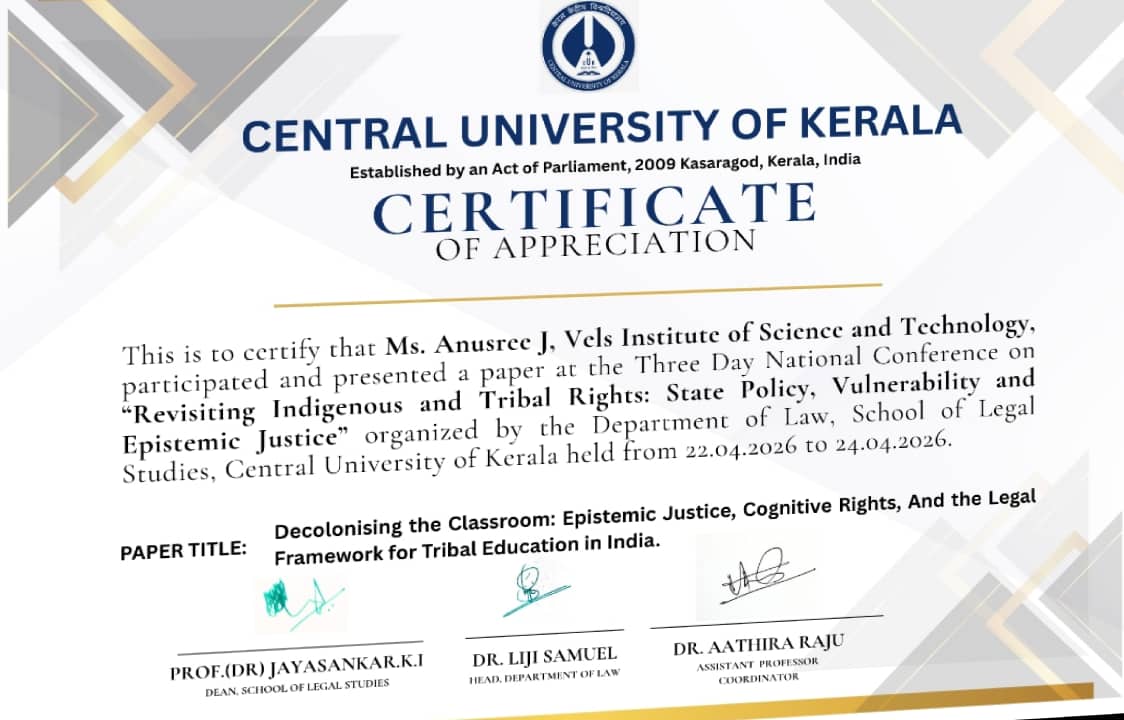
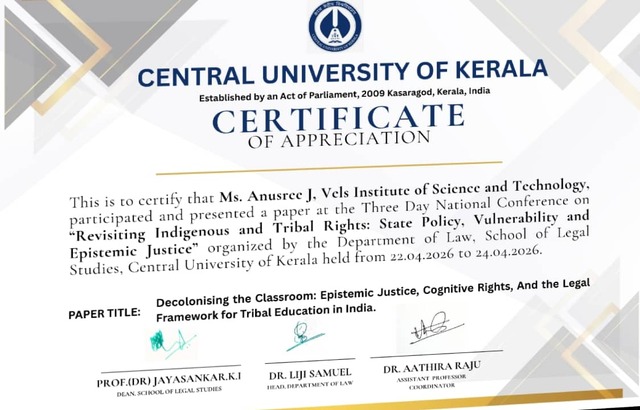
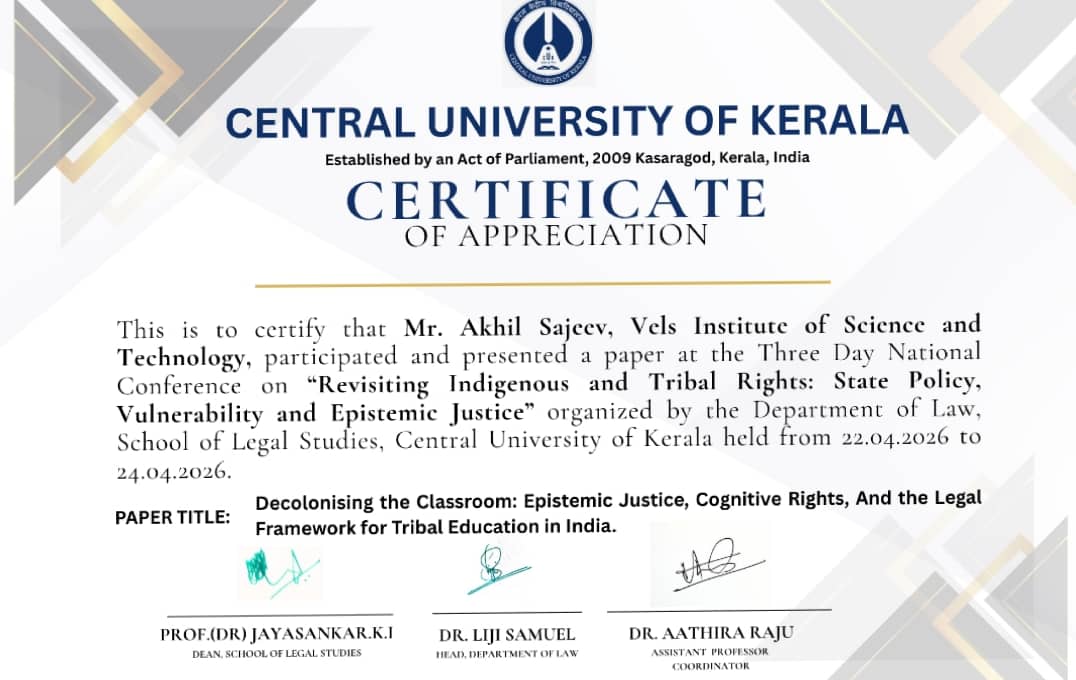
![[thumbnail of Anusree J 7113 Vistas_15.jpg]](https://ir.vistas.ac.in/15540/1/Anusree%20J%207113%20Vistas_15.jpg)
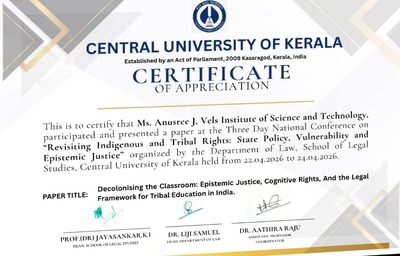
Anusree J 7113 Vistas_15.jpg - Accepted Version
Download (73kB) | Preview
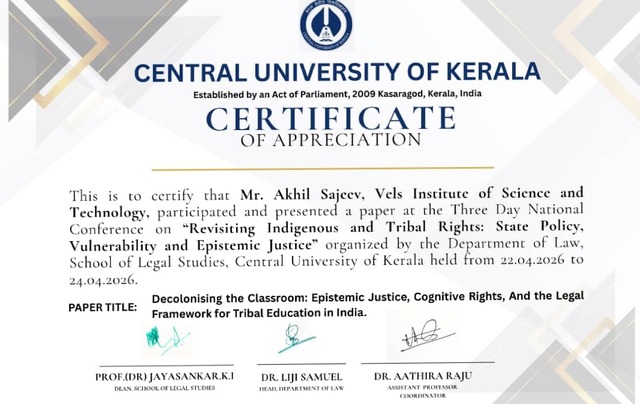
![[thumbnail of Akhil Sajeev 7106 Vistas_24.jpg]](https://ir.vistas.ac.in/15540/2/Akhil%20Sajeev%207106%20Vistas_24.jpg)
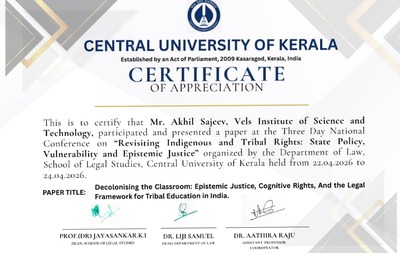
Akhil Sajeev 7106 Vistas_24.jpg - Published Version
Download (67kB) | Preview
![[thumbnail of Decolonising the Classroom Epistemic Justice, Cognitive Rights, and the Legal Framework for Tribal Education in India.docx]](https://ir.vistas.ac.in/style/images/fileicons/text.png) Text
Text
Decolonising the Classroom Epistemic Justice, Cognitive Rights, and the Legal Framework for Tribal Education in India.docx - Published Version
Download (34kB)
Abstract
The right to education, constitutionally guaranteed under Article 21A and elaborated through the Right of Children to Free and Compulsory Education Act, 2009, has long been proclaimed as a universal entitlement. Yet for India's Scheduled Tribe communities, formal schooling has frequently operated as a mechanism of epistemic erasure rather than authentic empowerment. This paper critically examines the intersection of tribal education, cognitive justice, and epistemic rights within India's contemporary legal framework, interrogating whether existing state policies sufficiently recognise and protect the knowledge systems, languages, and pedagogical traditions of indigenous peoples. Drawing upon Miranda Fricker's framework of epistemic justice and decolonial pedagogical theory, the paper argues that cognitive justice understood as the recognition of the equal validity of diverse knowledge traditions must be constitutionally repositioned as a justiciable right. Through doctrinal and analytical methodology, the paper reviews constitutional provisions, judicial pronouncements, and educational policies including the National Education Policy 2020 and the Tribal Sub-Plan framework, situating its analysis within SDG 4 (Quality Education) and SDG 10 (Reduced Inequalities). The paper concludes by advocating for legislative reform that explicitly recognises cognitive sovereignty as integral to tribal educational rights.
Keywords: Tribal Education; Epistemic Justice; Cognitive Justice; Indigenous Knowledge Systems; Constitutional Rights; Cognitive Sovereignty; SDG 4; SDG 10
| Item Type: | Conference or Workshop Item (Paper) |
|---|---|
| Subjects: | Legal Studies > Constitutional Law |
| Domains: | Legal Studies |
| Depositing User: | IR Admin |
| Date Deposited: | 12 May 2026 08:04 |
| Last Modified: | 12 May 2026 08:04 |
| URI: | https://ir.vistas.ac.in/id/eprint/15540 |
Actions (login required)

- View Item