
LEGAL CHALLENGES IN HANDLING ORPHANED AND ABANDONED CHILDREN: AN ANALYSIS
ATHIRA, V and SUBASANTHANU, A B (2026) LEGAL CHALLENGES IN HANDLING ORPHANED AND ABANDONED CHILDREN: AN ANALYSIS. White Black Legal International Law Journal, 3 (6). pp. 4-18. ISSN 2581-8503
![[thumbnail of WhatsApp Image 2026-05-09 at 14.32.52.jpeg]](https://ir.vistas.ac.in/20261/1/WhatsApp%20Image%202026-05-09%20at%2014.32.52.jpeg) Image
Image
WhatsApp Image 2026-05-09 at 14.32.52.jpeg
Download (164kB)
![[thumbnail of legal challenges in orphaned and abandoned children 2026-05-19 130156.png]](https://ir.vistas.ac.in/20261/2/legal%20challenges%20in%20orphaned%20and%20abandoned%20children%202026-05-19%20130156.png) Image
Image
legal challenges in orphaned and abandoned children 2026-05-19 130156.png
Download (425kB)
Abstract
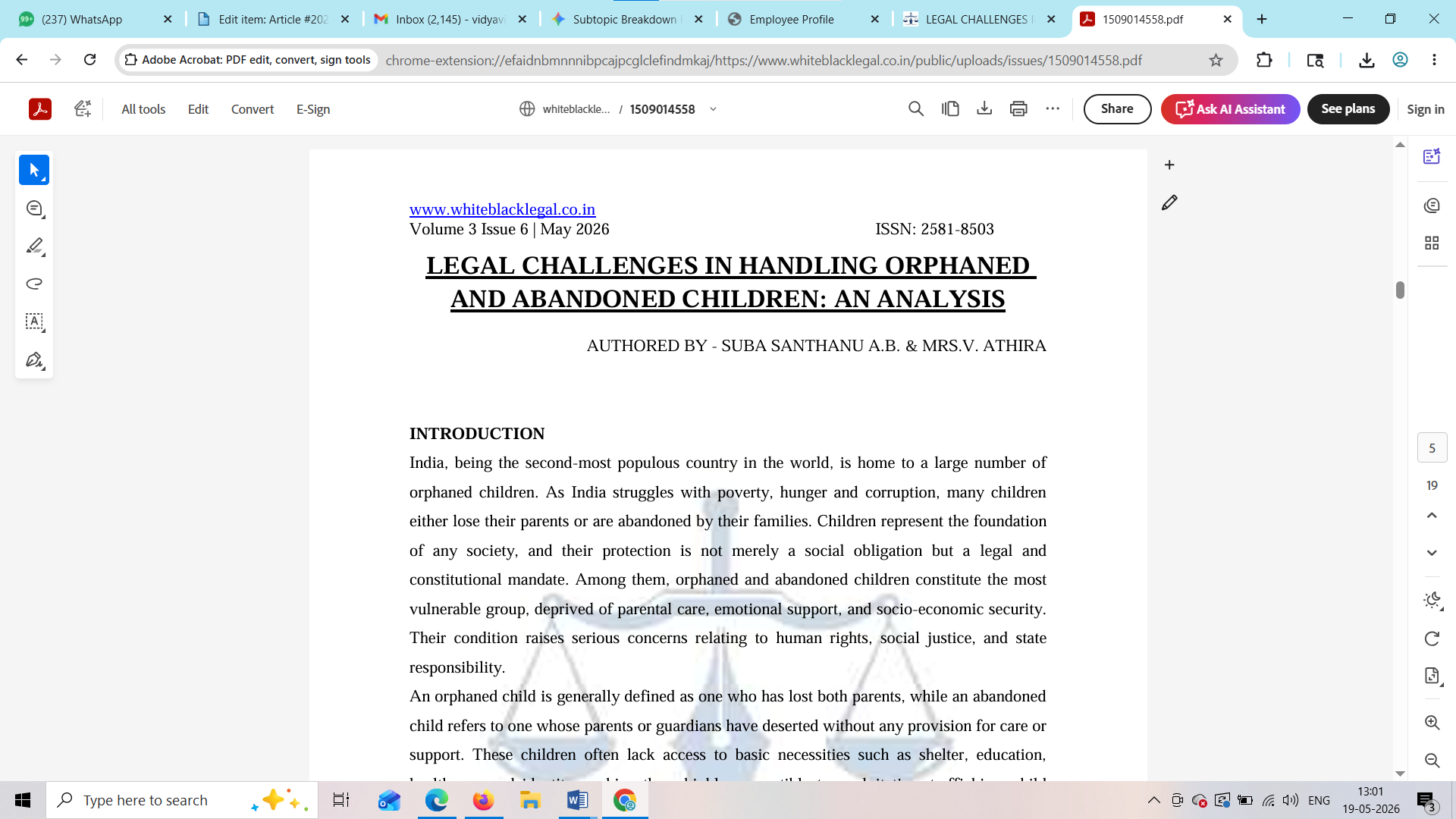
India, being the second-most populous country in the world, is home to a large number of
orphaned children. As India struggles with poverty, hunger and corruption, many children
either lose their parents or are abandoned by their families. Children represent the foundation
of any society, and their protection is not merely a social obligation but a legal and
constitutional mandate. Among them, orphaned and abandoned children constitute the most
vulnerable group, deprived of parental care, emotional support, and socio-economic security.
Their condition raises serious concerns relating to human rights, social justice, and state
responsibility.
An orphaned child is generally defined as one who has lost both parents, while an abandoned
child refers to one whose parents or guardians have deserted without any provision for care or
support. These children often lack access to basic necessities such as shelter, education,
healthcare, and identity, making them highly susceptible to exploitation, trafficking, child
labour, and abuse.
According to UNICEF, there were around 25 million orphaned children in India in 2007. With
the onset of the COVID-19 pandemic in 2020, the number of orphans in India has rapidly
increased. Hence, it is important to explore the existing legal framework in India that seeks to
protect orphans.
According to Article 39(f) of the Indian Constitution, the state can make policies to ensure that
children are provided with adequate opportunities and resources, which are essential to their
growth and to protect them from exploitation and abandonment. In most circumstances, only
an orphanage can provide orphaned children with basic necessities such as food, shelter,
clothing and education till the age of 14. Therefore, the state is empowered to make laws to
ensure that orphanages in the country are well-maintained and receive adequate funding in
order to protect the rights of orphaned children.
| Item Type: | Article |
|---|---|
| Subjects: | Legal Studies > Civil Law |
| Domains: | Legal Studies |
| Depositing User: | Mr IR Admin |
| Date Deposited: | 19 May 2026 08:28 |
| Last Modified: | 03 Sep 2026 09:08 |
| URI: | https://ir.vistas.ac.in/id/eprint/20261 |
Actions (login required)

- View Item