
Assessment Of Traditional Medicinal Plants as Antibiotic Adjuncts: Comprehensive Pharmacognostic And Antibacterial Evaluation of Neem, Pepper, Garlic, And Ginger With Herb–Streptomycin Interaction Analysis
Dr.S.JAYAKUMARI, Dr.S.JAYAKUMARI (2026) Assessment Of Traditional Medicinal Plants as Antibiotic Adjuncts: Comprehensive Pharmacognostic And Antibacterial Evaluation of Neem, Pepper, Garlic, And Ginger With Herb–Streptomycin Interaction Analysis. In: internatinal conference, january 30th 2026, yelreswaram .karkinda district , Andrapradesh.
![[thumbnail of conference procedings]](https://ir.vistas.ac.in/style/images/fileicons/other.png) Other (conference procedings)
Other (conference procedings)
ICBCCC SOUVENIR GDC YELESWARAM.pdf - Published Version
Download (4MB)
![[thumbnail of certificate]](https://ir.vistas.ac.in/18407/2/Green%20and%20White%20Minimalist%20Certificate%20of%20Participation%20%281%29.jpg) Image (certificate)
Image (certificate)
Green and White Minimalist Certificate of Participation (1).jpg - Presentation
Download (335kB)
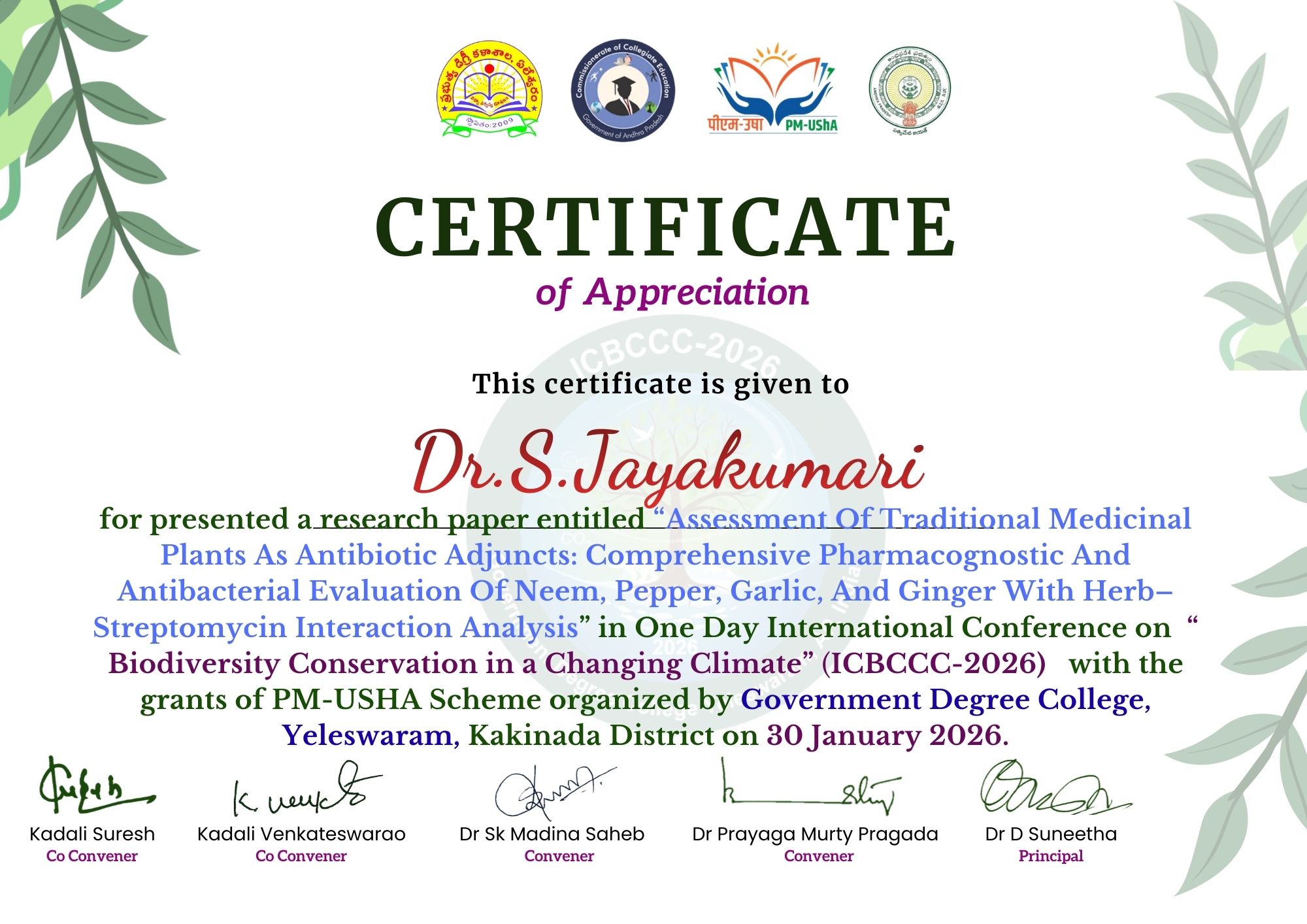
![[thumbnail of paper presentation certificate]](https://ir.vistas.ac.in/18407/3/IMG-20260206-WA0004.jpg) Image (paper presentation certificate)
Image (paper presentation certificate)
IMG-20260206-WA0004.jpg - Submitted Version
Download (155kB)
Abstract
The current study was initiated to examine the antimicrobial properties
of commonly used herbal draughtsmen Azadirachta indica (Neem), Piper
nigrum (Pepper), Allium sativum (Garlic), and Zingiber officinale (Ginger) as
potential adjuncts in the fight against drug-resistant pathogenic bacteria. The
current study was initiated in response to the increasing concern over
antimicrobial resistance (AMR) globally, which has been affecting antibiotic
medications in many ways. Following a series of pharmacogenetic tests,
including powder microscopy, powder extractive value, and other analyses, the
authenticity of the chosen plant drug was ascertained. On analyzing, it was
found that garlic has a high value of extractive yield, while microscopy tests
31showed characteristic features that allowed ascertaining that all four plant
samples were true to their type. Further phytochemical screening tests also
proved that all plant samples contained prominent standard metabolites, such
as alkaloids, tannins, flavonoids, and terpenoids. Agar well diffusion tests
further proved that pepper and ginger plant samples contained prominent
antibacterial properties. Further tests were done using minimum inhibitory
concentration analysis. Contrary to expectations, the minimum inhibitory
concentration of streptomycin and the extract mixture was found to be higher
(15.62 µg/mL) than that of streptomycin alone, which stood at 7.81 µg/mL, with
a FIC index of 3.0, proving it to be an antagonistic property. These findings
clearly point towards using these plant combinations in relation to
streptomycin, which would further hamper potency.
| Item Type: | Conference or Workshop Item (Paper) |
|---|---|
| Subjects: | Pharmacognosy > Phytochemistry |
| Domains: | Pharmacognosy |
| Depositing User: | IR Admin |
| Date Deposited: | 27 Aug 2026 05:56 |
| Last Modified: | 27 Aug 2026 05:57 |
| URI: | https://ir.vistas.ac.in/id/eprint/18407 |
Actions (login required)

- View Item