
STRAY DOGS: A LEGAL ANALYSIS ON BALANCING ANIMAL RIGHTS AND PUBLIC SAFETY
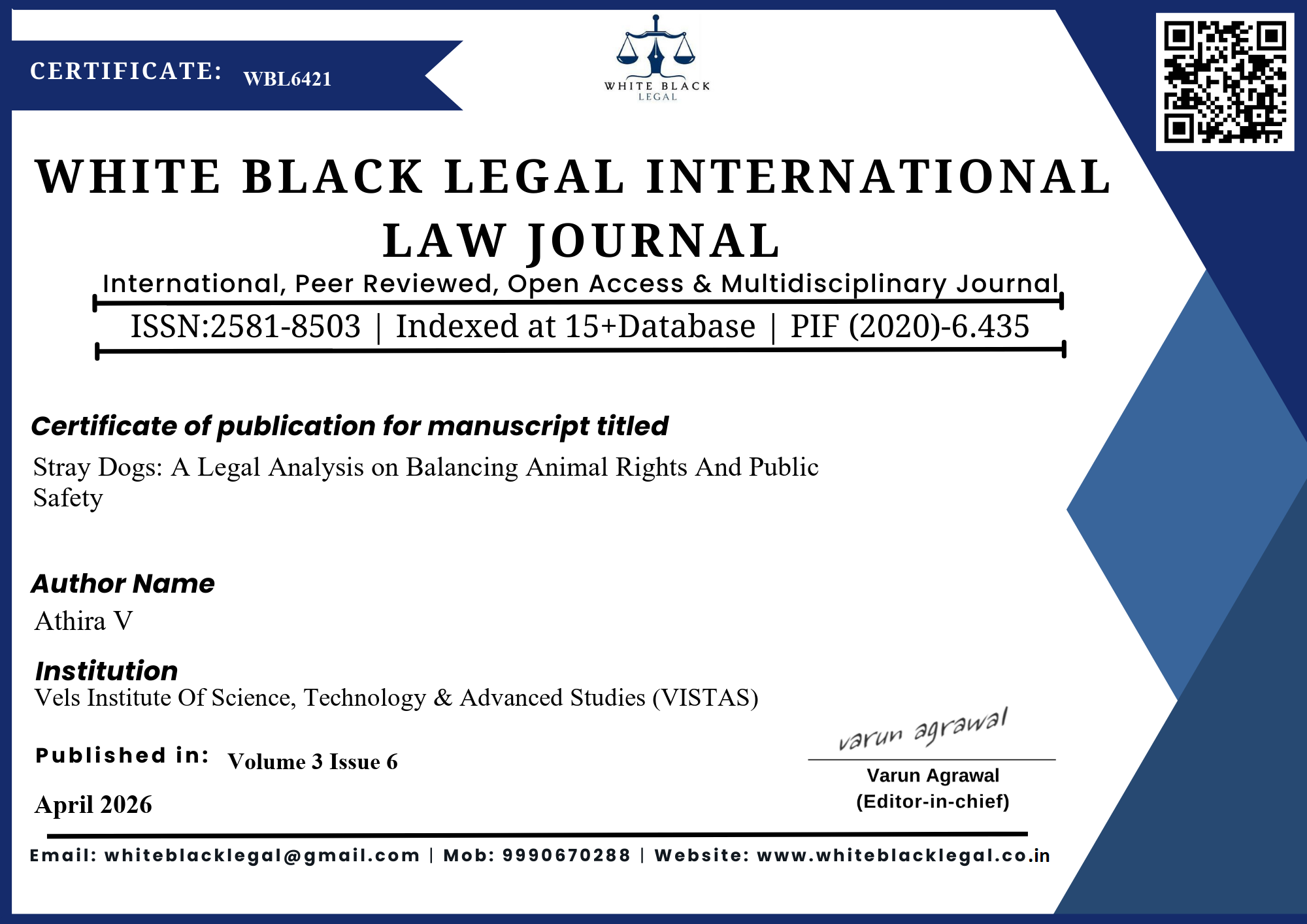
ATHIRA, V and Santhoshkumar, S (2026) STRAY DOGS: A LEGAL ANALYSIS ON BALANCING ANIMAL RIGHTS AND PUBLIC SAFETY. White Black Legal International Law Journal, 3 (6). pp. 4-14. ISSN 2581-8503
![[thumbnail of WBL6421_Athira_V.png]](https://ir.vistas.ac.in/17614/1/WBL6421_Athira_V.png) Image
Image
WBL6421_Athira_V.png
Download (272kB)
![[thumbnail of 236014994.pdf]](https://ir.vistas.ac.in/style/images/fileicons/text.png) Text
Text
236014994.pdf
Download (678kB)
Abstract
The issue of stray dogs in India has emerged as a significant legal and socio-economic concern, involving a complex interplay between public safety, animal welfare, and regulatory governance. With increasing urbanisation and inadequate waste management systems, the population of stray dogs has risen substantially, particularly in metropolitan and semi-urban areas. This rise has led to frequent incidents of dog bites, transmission of diseases such as rabies, and growing tensions between local communities and animal welfare activists. At the same time, the legal framework in India emphasises the humane treatment of animals, thereby creating a need to balance human interests with animal rights. Stray dogs occupy a unique position within the legal system, as they are neither privately owned animals nor entirely under the direct control of the State. This ambiguity in status complicates the application of legal principles relating to ownership, liability, and responsibility. While municipal authorities are tasked with managing stray dog populations, their powers are often limited by statutory provisions that prohibit cruelty and mandate humane treatment. As a result, authorities must adopt measures such as sterilisation and vaccination rather than elimination, which requires substantial resources and coordination. The importance of this study lies in its attempt to critically examine the legal framework governing stray dogs and the challenges associated with its implementation. The increasing number of public interest litigations and judicial interventions in this area highlights the urgency of addressing these issues. Courts have frequently been called upon to resolve conflicts between public safety concerns and animal welfare principles, resulting in significant jurisprudence. In the Indian context, the legal framework is primarily governed by statutes such as the Prevention of Cruelty to Animals Act, 1960 and the Animal Birth Control (Dogs) Rules, 2001 (as amended). These laws reflect a shift from traditional approaches of culling towards more humane methods of population control. However, the effectiveness of these measures has been questioned due to challenges in implementation, lack of infrastructure, and limited public awareness.
| Item Type: | Article |
|---|---|
| Subjects: | Legal Studies > Constitutional Law |
| Domains: | Legal Studies |
| Depositing User: | IR Admin |
| Date Deposited: | 11 May 2026 10:36 |
| Last Modified: | 03 Sep 2026 08:56 |
| URI: | https://ir.vistas.ac.in/id/eprint/17614 |
Actions (login required)

- View Item