
HUMAN PROTECTION IN THE CONTEXT OF SOCIAL JUSTICE (Women, Children and Marginalized Communities)
GODHAWARI, P and MURUGA SELVI, M (2026) HUMAN PROTECTION IN THE CONTEXT OF SOCIAL JUSTICE (Women, Children and Marginalized Communities). WHITE BLACK LEGAL INTERNATIONAL LAW JOURNAL, 3 (6): 17547. ISSN 2581-8503
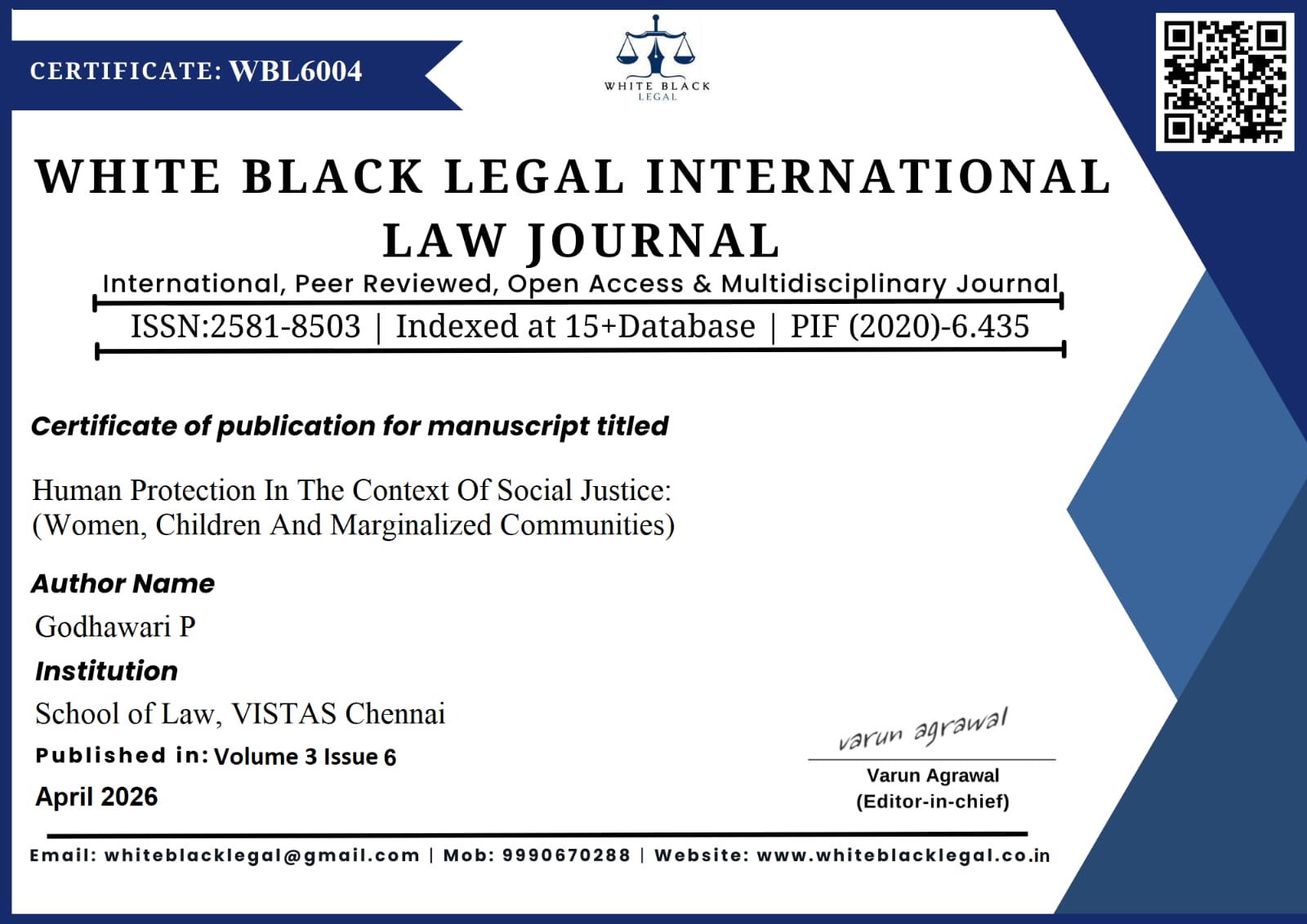
![[thumbnail of Human protection April 2026 project.jpeg]](https://ir.vistas.ac.in/17547/1/Human%20protection%20April%202026%20project.jpeg) Image
Image
Human protection April 2026 project.jpeg
Download (143kB)
Abstract
Human protection in the context of women, children, and marginalized communities is a central concern of social justice, as these groups experience disproportionate levesls of vulnerability due to structural inequality, discrimination, and limited access to resources and decision-making processes. Social, economic, cultural, and legal barriers often expose them to violence, exploitation, poverty, and exclusion from education, healthcare, and justice systems. Studies show that patriarchal norms, caste hierarchies, poverty, and weak enforcement of protective laws significantly undermine their human rights despite the existence of constitutional and international safeguards.This research adopts a human-rights-based and intersectional approach to examine the forms of structural violence affecting women, children, and marginalized groups and the role of legal frameworks, administrative institutions, and community-based interventions in ensuring protection and empowerment. Administrative mechanisms such as human rights commissions, social welfare schemes, and child protection laws provide formal safeguards, yet gaps in implementation, awareness, and accessibility continue to hinder effective protection. The study highlights the importance of participatory governance, legal aid, gender-sensitive policies, and grassroots mobilization in promoting dignity, equality, and access to justice. Empowerment through education, economic inclusion, and community engagement emerges as a key strategy for transforming beneficiaries from passive recipients of protection into active rights-holders.The paper concludes that achieving meaningful human protection requires not only legal reforms but also structural social change, stronger institutional accountability, and inclusive development policies that address the root causes of marginalization. Such an approach is essential for realizing substantive social justice and safeguarding the fundamental rights of women, children, and marginalized communities.
| Item Type: | Article |
|---|---|
| Subjects: | Legal Studies > Banking Law |
| Domains: | Legal Studies |
| Depositing User: | IR Admin |
| Date Deposited: | 11 May 2026 10:22 |
| Last Modified: | 12 May 2026 08:28 |
| URI: | https://ir.vistas.ac.in/id/eprint/17547 |
Actions (login required)

- View Item