
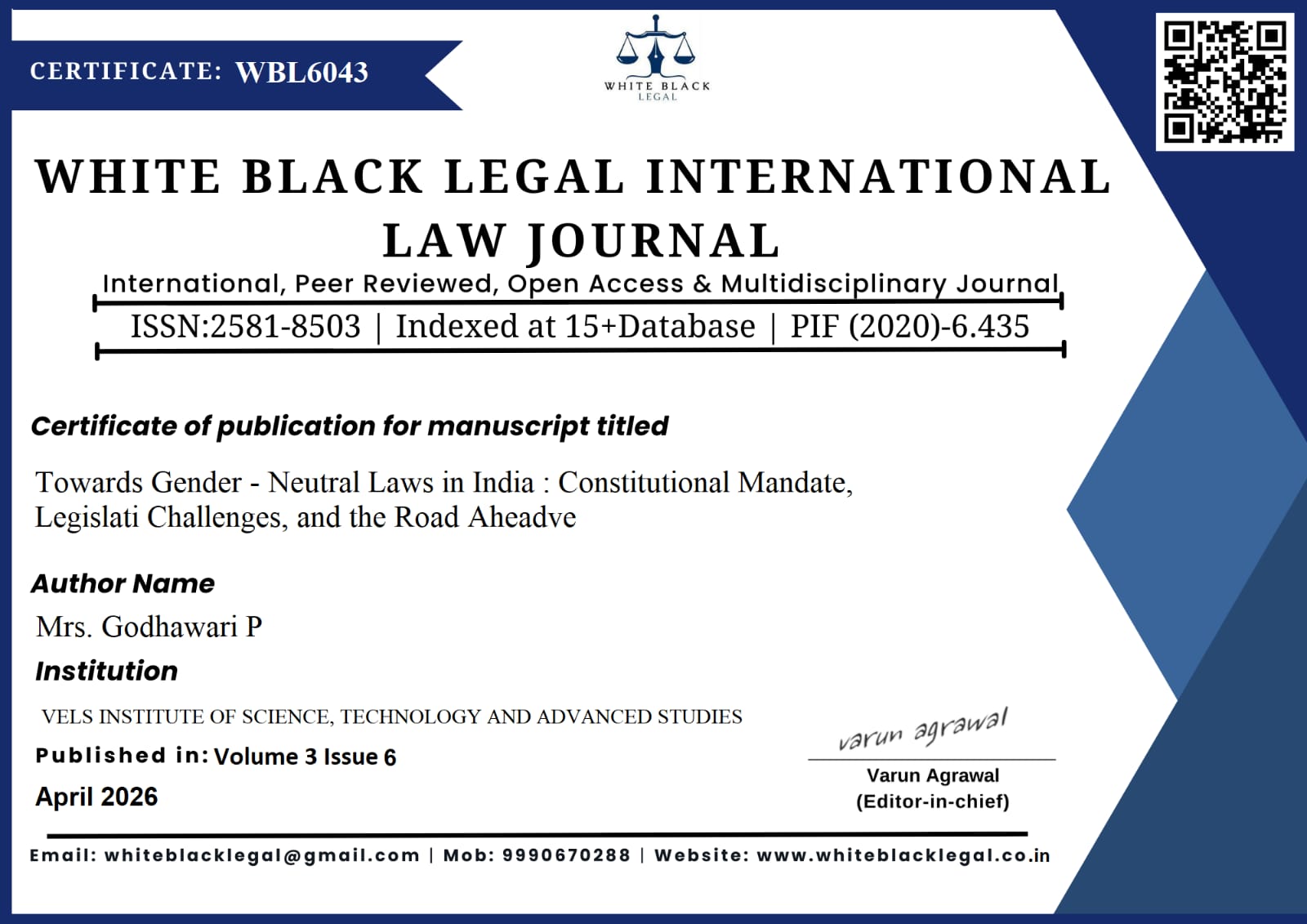
Towards Gender-Neutral Laws in India: Constitutional Mandate, Legislative Challenges, and the Road Ahead.
GODHAWARI, P and NARMADHA SHREE, M (2026) Towards Gender-Neutral Laws in India: Constitutional Mandate, Legislative Challenges, and the Road Ahead. WHITE BLACK LEGAL INTERNATIONAL LAW JOURNAL, 3 (6): 17018. ISSN 2581-8503
![[thumbnail of GENDER NUETRALITY APRIL 2026 Project.jpeg]](https://ir.vistas.ac.in/17018/1/GENDER%20NUETRALITY%20APRIL%202026%20Project.jpeg) Image
Image
GENDER NUETRALITY APRIL 2026 Project.jpeg - Published Version
Download (148kB)
Abstract
The Indian legal landscape, largely a byproduct of Victorian morality and colonial jurisprudence, has historically operated on a binary and protectionist paradigm. While the Constitution of India, under Articles 14, 15, and 21, mandates absolute equality and dignity for all persons, the substantive and procedural laws—ranging from the erstwhile Indian Penal Code to the newly enacted Bharatiya Nyaya Sanhita (BNS)—continue to maintain a gender-specific architecture. This research paper critically examines the "Equality Paradox" where special provisions for women, protected under Article 15(3), inadvertently result in the legal exclusion of male and transgender victims of sexual and domestic violence.
The study explores the transition from "Formal Equality" to "Substantive Equality," arguing that the current gender-specific nature of laws like Section 63 of the BNS (Rape) and the PWDV Act, 2005, creates a "protection vacuum" for non-female victims, thereby violating the doctrine of reasonable classification. By analyzing landmark judicial interventions such as NALSA v. Union of India and Navtej Singh Johar v. Union of India, the paper underscores the Judiciary's recognition of gender as a fluid spectrum, contrasting it with the Legislature's persistent inertia.
| Item Type: | Article |
|---|---|
| Subjects: | Legal Studies > Banking Law |
| Domains: | Legal Studies |
| Depositing User: | IR Admin |
| Date Deposited: | 13 May 2026 06:08 |
| Last Modified: | 13 May 2026 06:08 |
| URI: | https://ir.vistas.ac.in/id/eprint/17018 |
Actions (login required)

- View Item