
ARTIFICIAL INTELLIGENCE IN THE LEGAL FIELD: APPLICATIONS, BENEFITS, LIMITATIONS AND THE ROAD AHEAD
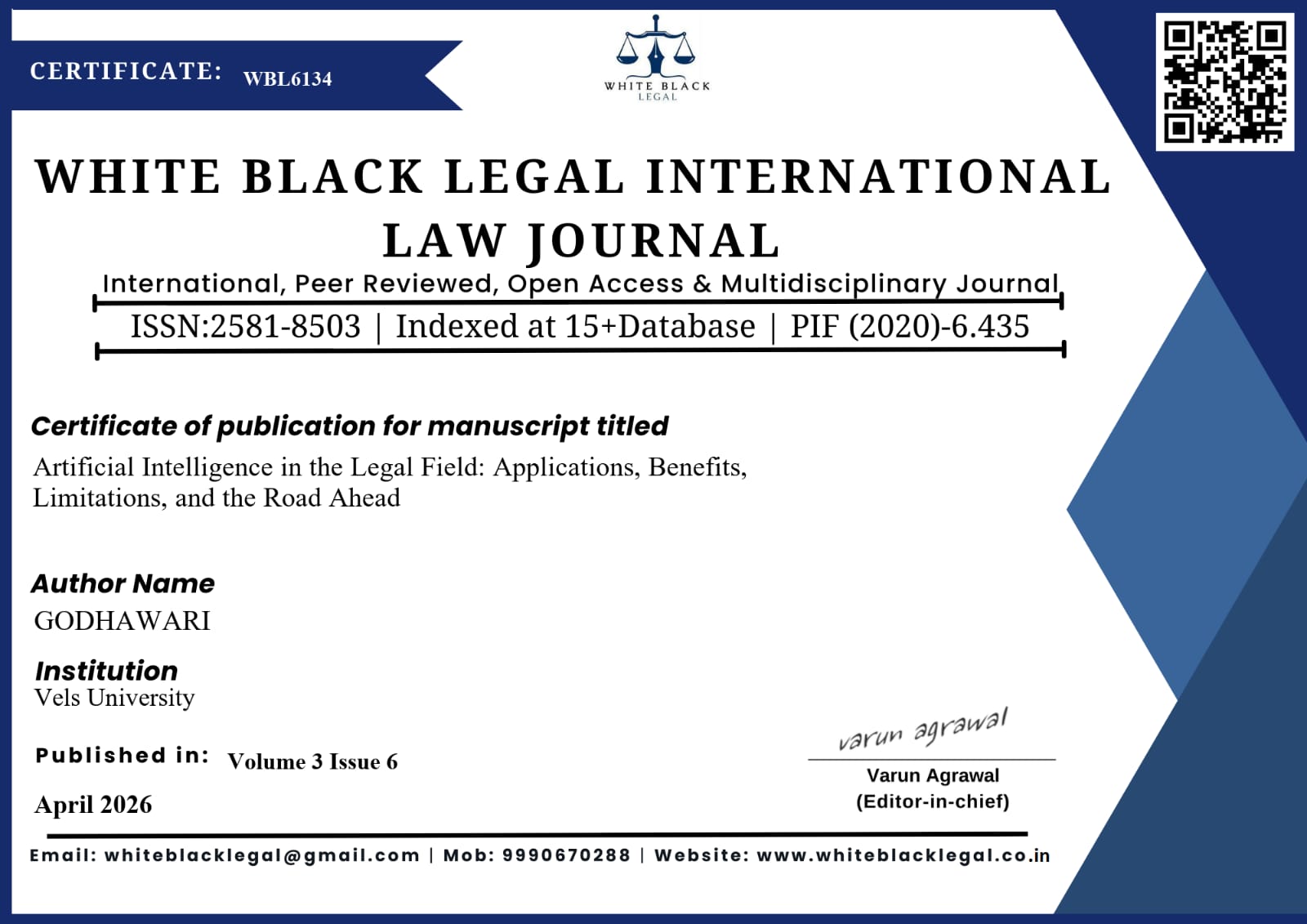
GODHAWARI, P and KALAISELVI, G (2026) ARTIFICIAL INTELLIGENCE IN THE LEGAL FIELD: APPLICATIONS, BENEFITS, LIMITATIONS AND THE ROAD AHEAD. WHITE BLACK LEGAL INTERNATIONAL JOURNAL, 3 (6): 16888. ISSN 2581-8503
![[thumbnail of ARTIFICIAL INT APRIL 2026 Project.jpeg]](https://ir.vistas.ac.in/16888/1/ARTIFICIAL%20INT%20APRIL%202026%20Project.jpeg)

ARTIFICIAL INT APRIL 2026 Project.jpeg - Published Version
Download (133kB) | Preview

Abstract
Artificial Intelligence has emerged as a significant technological development influencing various sectors, including the legal field. This paper examines the role of Artificial Intelligence in legal systems, focusing on its applications, benefits, limitations and future prospects. The study analyses how AI is used in legal research, contract review, predictive analytics, case management and dispute resolution. It highlights the advantages of AI such as improved efficiency, cost reduction and better access to legal information. At the same time, the study critically examines the challenges associated with Artificial Intelligence, including algorithmic bias, lack of transparency, accountability issues and data privacy concerns. The research adopts a doctrinal methodology based on analysis of statutes, judicial decisions and academic literature. It also discusses the need for proper regulatory frameworks to ensure responsible use of AI in the legal field. The study concludes that while Artificial Intelligence offers valuable support to legal systems, it cannot replace human judgment. A balanced approach is necessary to integrate AI into law without compromising fundamental legal principles.
| Item Type: | Article |
|---|---|
| Subjects: | Legal Studies > Banking Law |
| Domains: | Legal Studies |
| Depositing User: | IR Admin |
| Date Deposited: | 13 May 2026 06:07 |
| Last Modified: | 13 May 2026 06:07 |
| URI: | https://ir.vistas.ac.in/id/eprint/16888 |
Actions (login required)

- View Item