
RENAL SAFETY AND FUNCTIONAL STABILITY OF TORSEMIDE IN PATIENTS WITH CHRONIC KIDNEY DISEASE AND HEART FAILURE: A COMPREHENSIVE REVIEW
K, Dr.Bharathi Priya and E.P, .Koushik kumaran, (2026) RENAL SAFETY AND FUNCTIONAL STABILITY OF TORSEMIDE IN PATIENTS WITH CHRONIC KIDNEY DISEASE AND HEART FAILURE: A COMPREHENSIVE REVIEW. APP 2026 - 165 . INDO-KOREAN APP 2026. ISBN 978-81-992034-2-6
![[thumbnail of 6.png]](https://ir.vistas.ac.in/16860/1/6.png)

6.png - Published Version
Available under License Creative Commons Public Domain Dedication.
Download (166kB) | Preview

Abstract
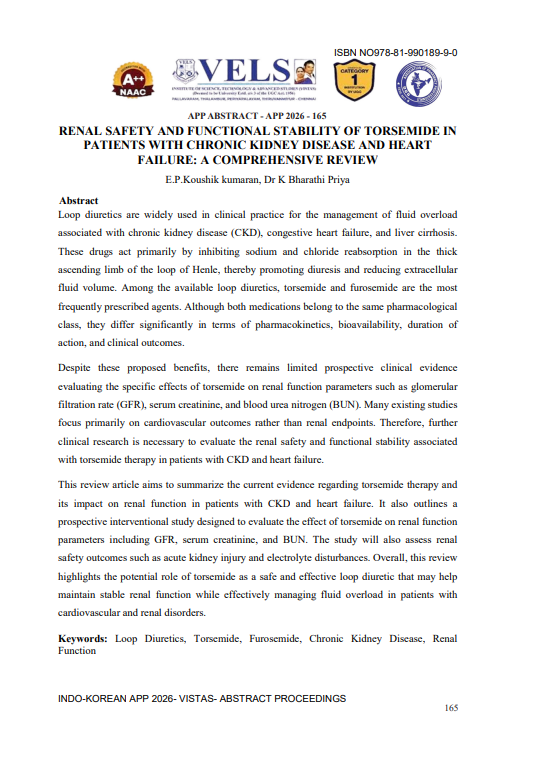
Loop diuretics are widely used in clinical practice for the management of fluid overload associated with chronic kidney disease (CKD), congestive heart failure, and liver cirrhosis. These drugs act primarily by inhibiting sodium and chloride reabsorption in the thick ascending limb of the loop of Henle, thereby promoting diuresis and reducing extracellular fluid volume. Among the available loop diuretics, torsemide and furosemide are the most frequently prescribed agents. Although both medications belong to the same pharmacological class, they differ significantly in terms of pharmacokinetics, bioavailability, duration of action, and clinical outcomes. Despite these proposed benefits, there remains limited prospective clinical evidence evaluating the specific effects of torsemide on renal function parameters such as glomerular filtration rate (GFR), serum creatinine, and blood urea nitrogen (BUN). Many existing studies focus primarily on cardiovascular outcomes rather than renal endpoints. Therefore, further clinical research is necessary to evaluate the renal safety and functional stability associated with torsemide therapy in patients with CKD and heart failure. This review article aims to summarize the current evidence regarding torsemide therapy and its impact on renal function in patients with CKD and heart failure. It also outlines a prospective interventional study designed to evaluate the effect of torsemide on renal function parameters including GFR, serum creatinine, and BUN. The study will also assess renal safety outcomes such as acute kidney injury and electrolyte disturbances. Overall, this review highlights the potential role of torsemide as a safe and effective loop diuretic that may help maintain stable renal function while effectively managing fluid overload in patients with cardiovascular and renal disorders.
| Item Type: | Book |
|---|---|
| Uncontrolled Keywords: | Loop Diuretics, Torsemide, Furosemide, Chronic Kidney Disease, Renal function |
| Subjects: | Pharmacy Practice > Pharmacy Practice |
| Domains: | Pharmacy Practice |
| Depositing User: | Mr IR Admin |
| Date Deposited: | 11 May 2026 10:21 |
| Last Modified: | 11 May 2026 10:21 |
| URI: | https://ir.vistas.ac.in/id/eprint/16860 |
Actions (login required)

- View Item