ROLE OF NANOTECHNOLOGY IN TARGETED ANTIMICROBIAL DRUG DELIVERY
Anirudh, S and Bharathi Priya, K and Karthickeyan., K (2026) ROLE OF NANOTECHNOLOGY IN TARGETED ANTIMICROBIAL DRUG DELIVERY. APP 2026 - 159 . INDO-KOREAN APP 2026, India. ISBN 978-81-992034-2-6
![[thumbnail of 5.png]](http://ir.vistas.ac.in/16855/1/5.png)
5.png - Published Version
Available under License Creative Commons Public Domain Dedication.
Download (150kB) | Preview
Abstract
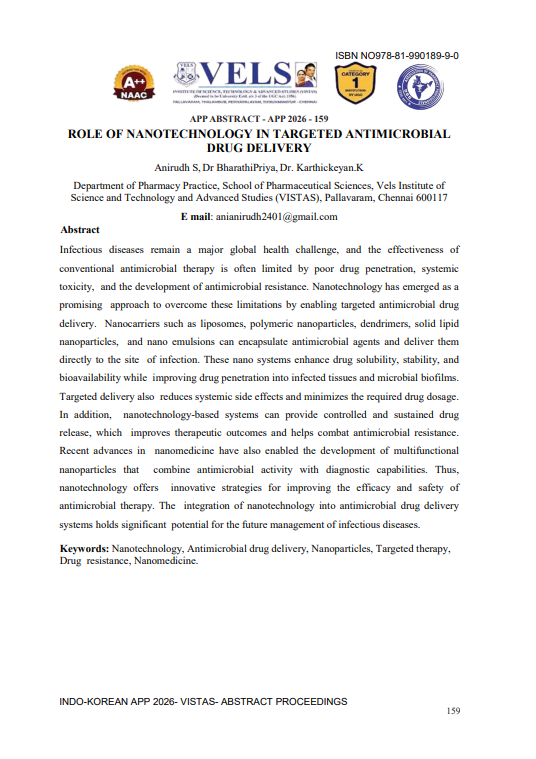
Infectious diseases remain a major global health challenge, and the effectiveness of conventional antimicrobial therapy is often limited by poor drug penetration, systemic toxicity, and the development of antimicrobial resistance. Nanotechnology has emerged as a promising approach to overcome these limitations by enabling targeted antimicrobial drug delivery. Nanocarriers such as liposomes, polymeric nanoparticles, dendrimers, solid lipid nanoparticles, and nano emulsions can encapsulate antimicrobial agents and deliver them directly to the site of infection. These nano systems enhance drug solubility, stability, and bioavailability while improving drug penetration into infected tissues and microbial biofilms. Targeted delivery also reduces systemic side effects and minimizes the required drug dosage. In addition, nanotechnology-based systems can provide controlled and sustained drug release, which improves therapeutic outcomes and helps combat antimicrobial resistance. Recent advances in nanomedicine have also enabled the development of multifunctional nanoparticles that combine antimicrobial activity with diagnostic capabilities. Thus, nanotechnology offers innovative strategies for improving the efficacy and safety of antimicrobial therapy. The integration of nanotechnology into antimicrobial drug delivery systems holds significant potential for the future management of infectious diseases.
| Item Type: | Book |
|---|---|
| Uncontrolled Keywords: | Infectious diseases remain a major global health challenge, and the effectiveness of conventional antimicrobial therapy is often limited by poor drug penetration, systemic toxicity, and the development of antimicrobial resistance. Nanotechnology has emerged as a promising approach to overcome these limitations by enabling targeted antimicrobial drug delivery. Nanocarriers such as liposomes, polymeric nanoparticles, dendrimers, solid lipid nanoparticles, and nano emulsions can encapsulate antimicrobial agents and deliver them directly to the site of infection. These nano systems enhance drug solubility, stability, and bioavailability while improving drug penetration into infected tissues and microbial biofilms. Targeted delivery also reduces systemic side effects and minimizes the required drug dosage. In addition, nanotechnology-based systems can provide controlled and sustained drug release, which improves therapeutic outcomes and helps combat antimicrobial resistance. Recent advances in nanomedicine have also enabled the development of multifunctional nanoparticles that combine antimicrobial activity with diagnostic capabilities. Thus, nanotechnology offers innovative strategies for improving the efficacy and safety of antimicrobial therapy. The integration of nanotechnology into antimicrobial drug delivery systems holds significant potential for the future management of infectious diseases |
| Subjects: | Pharmacy Practice > Pharmacy Practice |
| Domains: | Pharmacy Practice |
| Depositing User: | IR Admin |
| Date Deposited: | 11 May 2026 10:57 |
| Last Modified: | 01 Sep 2026 07:10 |
| URI: | https://ir.vistas.ac.in/id/eprint/16855 |
Actions (login required)

- View Item
 Altmetric
 Altmetric