
LIPOSOMAL AND NANOPARTICLE DRUG DELIVERY SYSTEMS FOR IMPROVING ANTIBIOTIC BIOAVAILABILITY IN RESISTANT BACTERIAL INFECTIONS
Tomsy Maryann, D and Bharathi Priya, K (2026) LIPOSOMAL AND NANOPARTICLE DRUG DELIVERY SYSTEMS FOR IMPROVING ANTIBIOTIC BIOAVAILABILITY IN RESISTANT BACTERIAL INFECTIONS. APP 2026 - 089 . INDO-KOREAN APP 2026, India. ISBN NO978-81-990189-9-0
![[thumbnail of 3.png]](https://ir.vistas.ac.in/16848/1/3.png) Image
Image
3.png - Published Version
Available under License Creative Commons Public Domain Dedication.
Download (156kB)
Abstract
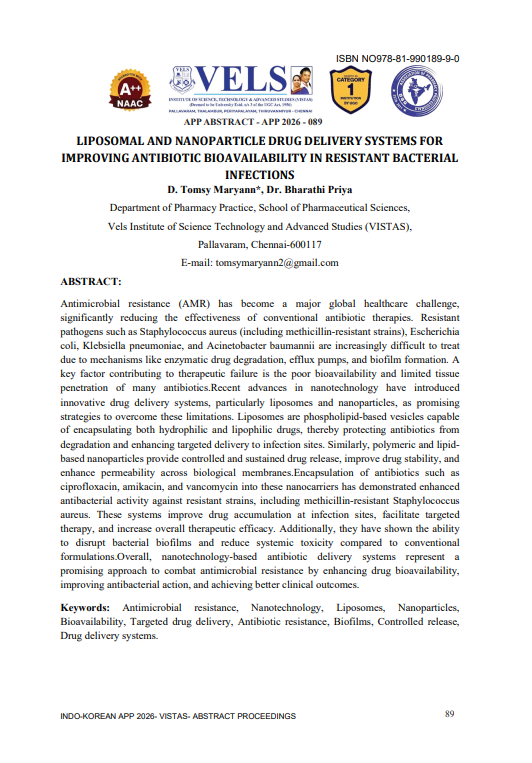
Antimicrobial resistance (AMR) has become a major global healthcare challenge, significantly reducing the effectiveness of conventional antibiotic therapies. Resistant pathogens such as Staphylococcus aureus (including methicillin-resistant strains), Escherichia coli, Klebsiella pneumoniae, and Acinetobacter baumannii are increasingly difficult to treat due to mechanisms like enzymatic drug degradation, efflux pumps, and biofilm formation. A key factor contributing to therapeutic failure is the poor bioavailability and limited tissue penetration of many antibiotics.Recent advances in nanotechnology have introduced innovative drug delivery systems, particularly liposomes and nanoparticles, as promising strategies to overcome these limitations. Liposomes are phospholipid-based vesicles capable of encapsulating both hydrophilic and lipophilic drugs, thereby protecting antibiotics from degradation and enhancing targeted delivery to infection sites. Similarly, polymeric and lipidbased nanoparticles provide controlled and sustained drug release, improve drug stability, and enhance permeability across biological membranes.Encapsulation of antibiotics such as ciprofloxacin, amikacin, and vancomycin into these nanocarriers has demonstrated enhanced antibacterial activity against resistant strains, including methicillin-resistant Staphylococcus aureus. These systems improve drug accumulation at infection sites, facilitate targeted therapy, and increase overall therapeutic efficacy. Additionally, they have shown the ability to disrupt bacterial biofilms and reduce systemic toxicity compared to conventional formulations.Overall, nanotechnology-based antibiotic delivery systems represent a promising approach to combat antimicrobial resistance by enhancing drug bioavailability, improving antibacterial action, and achieving better clinical outcomes.
| Item Type: | Book |
|---|---|
| Uncontrolled Keywords: | Antimicrobial resistance, Nanotechnology, Liposomes, Nanoparticles, Bioavailability, Targeted drug delivery, Antibiotic resistance, Biofilms, Controlled release |
| Subjects: | Pharmacy Practice > Pharmacy Practice |
| Domains: | Pharmacy Practice |
| Depositing User: | IR Admin |
| Date Deposited: | 11 May 2026 09:49 |
| Last Modified: | 01 Sep 2026 07:01 |
| URI: | https://ir.vistas.ac.in/id/eprint/16848 |
Actions (login required)

- View Item