
EXOSOMES AS INNOVATIVE NANOCARRIERS FOR TARGETED AND PERSONALIZED DRUG DELIVERY
Hariharan, R.B. and Dhanush, M and Bharathi Priya, K (2026) EXOSOMES AS INNOVATIVE NANOCARRIERS FOR TARGETED AND PERSONALIZED DRUG DELIVERY. APP 2026 - 084 (084). INDO-KOREAN APP 2026, India. ISBN 978-81-992034-2-6
![[thumbnail of 1.png]](https://ir.vistas.ac.in/16831/1/1.png)

1.png - Published Version
Available under License Creative Commons Public Domain Dedication.
Download (141kB) | Preview

Abstract
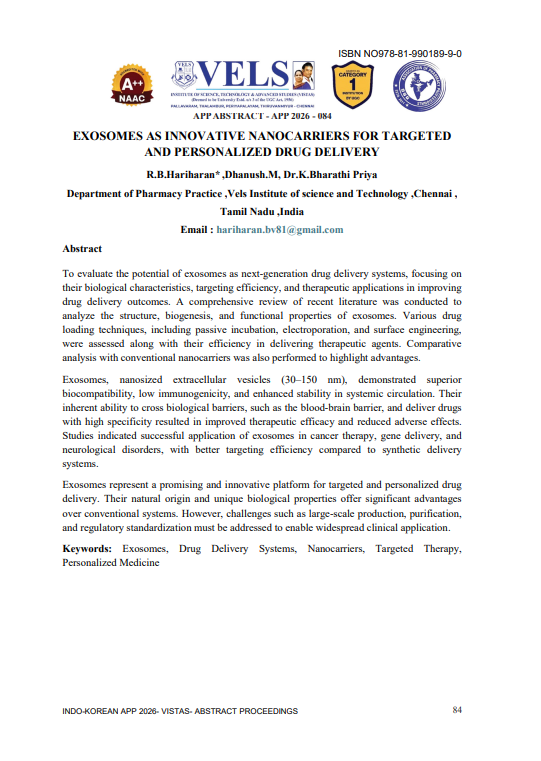
To evaluate the potential of exosomes as next-generation drug delivery systems, focusing on their biological characteristics, targeting efficiency, and therapeutic applications in improving drug delivery outcomes. A comprehensive review of recent literature was conducted to analyze the structure, biogenesis, and functional properties of exosomes. Various drug loading techniques, including passive incubation, electroporation, and surface engineering, were assessed along with their efficiency in delivering therapeutic agents. Comparative analysis with conventional nanocarriers was also performed to highlight advantages. Exosomes, nanosized extracellular vesicles (30–150 nm), demonstrated superior biocompatibility, low immunogenicity, and enhanced stability in systemic circulation. Their inherent ability to cross biological barriers, such as the blood-brain barrier, and deliver drugs with high specificity resulted in improved therapeutic efficacy and reduced adverse effects. Studies indicated successful application of exosomes in cancer therapy, gene delivery, and neurological disorders, with better targeting efficiency compared to synthetic delivery systems. Exosomes represent a promising and innovative platform for targeted and personalized drug delivery. Their natural origin and unique biological properties offer significant advantages over conventional systems. However, challenges such as large-scale production, purification, and regulatory standardization must be addressed to enable widespread clinical application.
| Item Type: | Book |
|---|---|
| Uncontrolled Keywords: | To evaluate the potential of exosomes as next-generation drug delivery systems, focusing on their biological characteristics, targeting efficiency, and therapeutic applications in improving drug delivery outcomes. A comprehensive review of recent literature was conducted to analyze the structure, biogenesis, and functional properties of exosomes. Various drug loading techniques, including passive incubation, electroporation, and surface engineering, were assessed along with their efficiency in delivering therapeutic agents. Comparative analysis with conventional nanocarriers was also performed to highlight advantages. Exosomes, nanosized extracellular vesicles (30–150 nm), demonstrated superior biocompatibility, low immunogenicity, and enhanced stability in systemic circulation. Their inherent ability to cross biological barriers, such as the blood-brain barrier, and deliver drugs with high specificity resulted in improved therapeutic efficacy and reduced adverse effects. Studies indicated successful application of exosomes in cancer therapy, gene delivery, and neurological disorders, with better targeting efficiency compared to synthetic delivery systems. Exosomes represent a promising and innovative platform for targeted and personalized drug delivery. Their natural origin and unique biological properties offer significant advantages over conventional systems. However, challenges such as large-scale production, purification, and regulatory standardization must be addressed to enable widespread clinical application. |
| Subjects: | Pharmacy Practice > Pharmacology |
| Domains: | Pharmacy Practice |
| Depositing User: | IR Admin |
| Date Deposited: | 12 May 2026 05:16 |
| Last Modified: | 01 Sep 2026 06:50 |
| URI: | https://ir.vistas.ac.in/id/eprint/16831 |
Actions (login required)

- View Item