
A Comprehensive Review of the Phytochemical Constituents and Diverse Pharmacological Applications of Diospyros kaki (Persimmon) Across Traditional and Modern Medicine.
Bin Emran, Talha and Amin, Md Al and Sutradhar, Baishakhi and Sweilam, Sherouk Hussein and Shanmugarajan, Thukani Sathanantham and Arjun, Uppuluri Varuna Naga Venkata and Durairaj, Akiladevi and Mahesh, Ponnammal Ganesan and Jebastine, M Immanuel and Prasad, P Dharani and Suliman, Muath and Zia Uddin, Md (2026) A Comprehensive Review of the Phytochemical Constituents and Diverse Pharmacological Applications of Diospyros kaki (Persimmon) Across Traditional and Modern Medicine. Current topics in medicinal chemistry. ISSN 1873-4294
![[thumbnail of ACOMPR~1.JPG]](https://ir.vistas.ac.in/16560/1/ACOMPR~1.JPG)
ACOMPR~1.JPG
Download (214kB) | Preview
Abstract
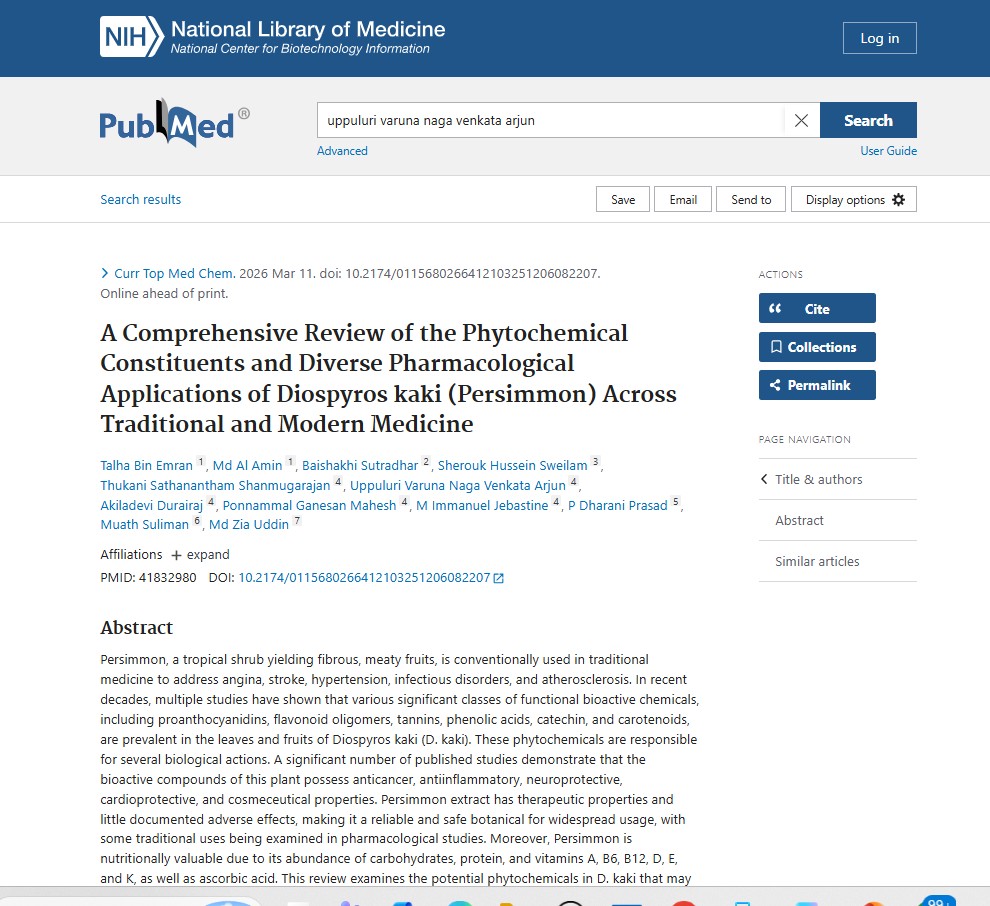
Persimmon, a tropical shrub yielding fibrous, meaty fruits, is conventionally used in traditional medicine to address angina, stroke, hypertension, infectious disorders, and atherosclerosis. In recent decades, multiple studies have shown that various significant classes of functional bioactive chemicals, including proanthocyanidins, flavonoid oligomers, tannins, phenolic acids, catechin, and carotenoids, are prevalent in the leaves and fruits of Diospyros kaki (D. kaki). These phytochemicals are responsible for several biological actions. A significant number of published studies demonstrate that the bioactive compounds of this plant possess anticancer, antiinflammatory, neuroprotective, cardioprotective, and cosmeceutical properties. Persimmon extract has therapeutic properties and little documented adverse effects, making it a reliable and safe botanical for widespread usage, with some traditional uses being examined in pharmacological studies. Moreover, Persimmon is nutritionally valuable due to its abundance of carbohydrates, protein, and vitamins A, B6, B12, D, E, and K, as well as ascorbic acid. This review examines the potential phytochemicals in D. kaki that may be effective in treating various diseases, alongside in vitro pharmacological studies, in vivo pre-clinical research, toxicological assessments, and future research prospects for this plant, which is rich in multifunctional nutrients.
| Item Type: | Article |
|---|---|
| Depositing User: | Mr IR Admin |
| Last Modified: | 11 May 2026 07:35 |
| URI: | https://ir.vistas.ac.in/id/eprint/16560 |
Actions (login required)

- View Item