
Beyond Intellectual Property: A Sui Generis Framework for the Protection of Traditional Knowledge and Cultural Expressions
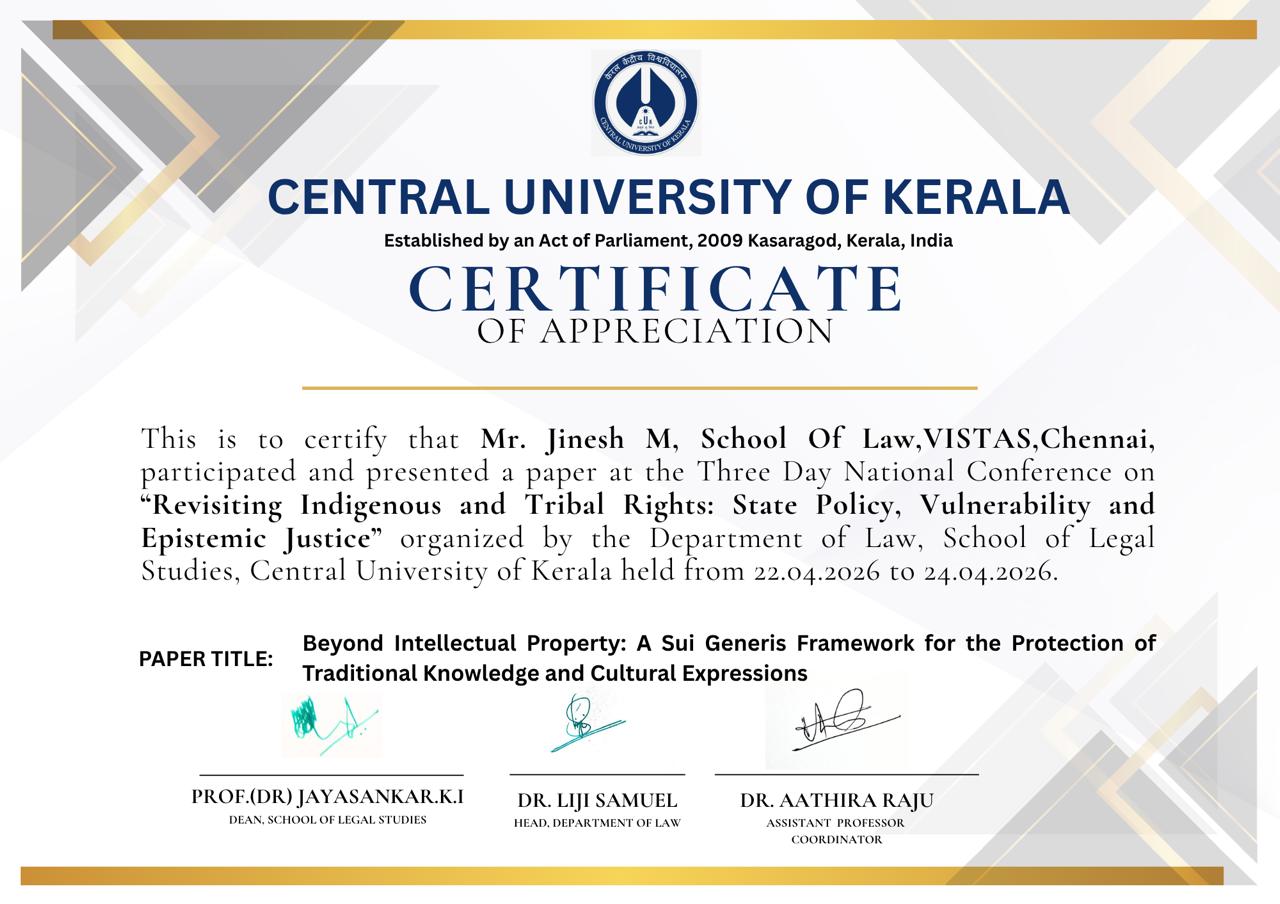
Jinesh, M (2026) Beyond Intellectual Property: A Sui Generis Framework for the Protection of Traditional Knowledge and Cultural Expressions. In: Three Day National Conference on "Revisiting Indigenous and Tribal Rights: State Policy, Vulnerability and Epistemic Justice.
![[thumbnail of CUK.jpg]](https://ir.vistas.ac.in/15709/1/CUK.jpg)

CUK.jpg
Download (128kB) | Preview

Abstract
The widespread abuse and commercialization of Traditional knowledge and Traditional cultural Expressions by non-indigenous actors constitute a significant problem in modern international law. The core research issue considered in this article is the inherent limitations of the existing Intellectual property system based on western principles of individuality, novelty, and limited lifespan in protecting indigenous knowledge that is intrinsically collective, inter-generational, and ever-evolving. The main research question posed in this article is an assessment of the fundamental shortcomings of prevailing international IP laws, particularly the TRIPS Agreement, in guaranteeing the rights of indigenous groups. Moreover, the study seeks to devise an effective sui generis legal system that honors the customary laws of traditional societies.
In order to accomplish these aims, this study adopts a qualitative approach, which is primarily based on comparative legal research. It conducts an in-depth study of the relevant legal documents, such as international treaties, draft provisions currently under discussion at the WIPO Intergovernmental Committee, and innovative national laws. This theoretical analysis is supplemented by empirical studies conducted in the context of biopiracy and cultural appropriation, which effectively demonstrate the inadequacies of current patent, copyright, and trademark regimes in relation to indigenous heritage.
The central argument that forms the basis of the analysis in this paper is the proposition that efforts aimed at forcing TK and TCEs into the highly commodified compartments of traditional IP are erroneous. This methodology not only reduces TK to mere commercial commodities but also removes it from its holistic and spiritual contexts. It is imperative for a new paradigm to emerge, where the assessment of IP would be human-centric rather than purely economic.
It is expected that the results would show that although measures such as TKDL may be moderately effective in stopping false patents, they do not give positive, practical rights to the knowledge owners. This study concludes that only defensive efforts will not be enough. A legally enforceable international agreement on the basis of PIC, MAT, and the official recognition of indigenous customary law is absolutely necessary. It will be necessary to go beyond mere protection to empower the right knowledge owners.
| Item Type: | Conference or Workshop Item (Paper) |
|---|---|
| Subjects: | Legal Studies > Intellectual Property Law |
| Domains: | Legal Studies |
| Depositing User: | Mr IR Admin |
| Date Deposited: | 11 May 2026 04:49 |
| Last Modified: | 19 May 2026 16:09 |
| URI: | https://ir.vistas.ac.in/id/eprint/15709 |
Actions (login required)

- View Item