
Machines, Authorship, and the Law: Rethinking Intellectual Property Frameworks in the Age of Artificial Intelligence
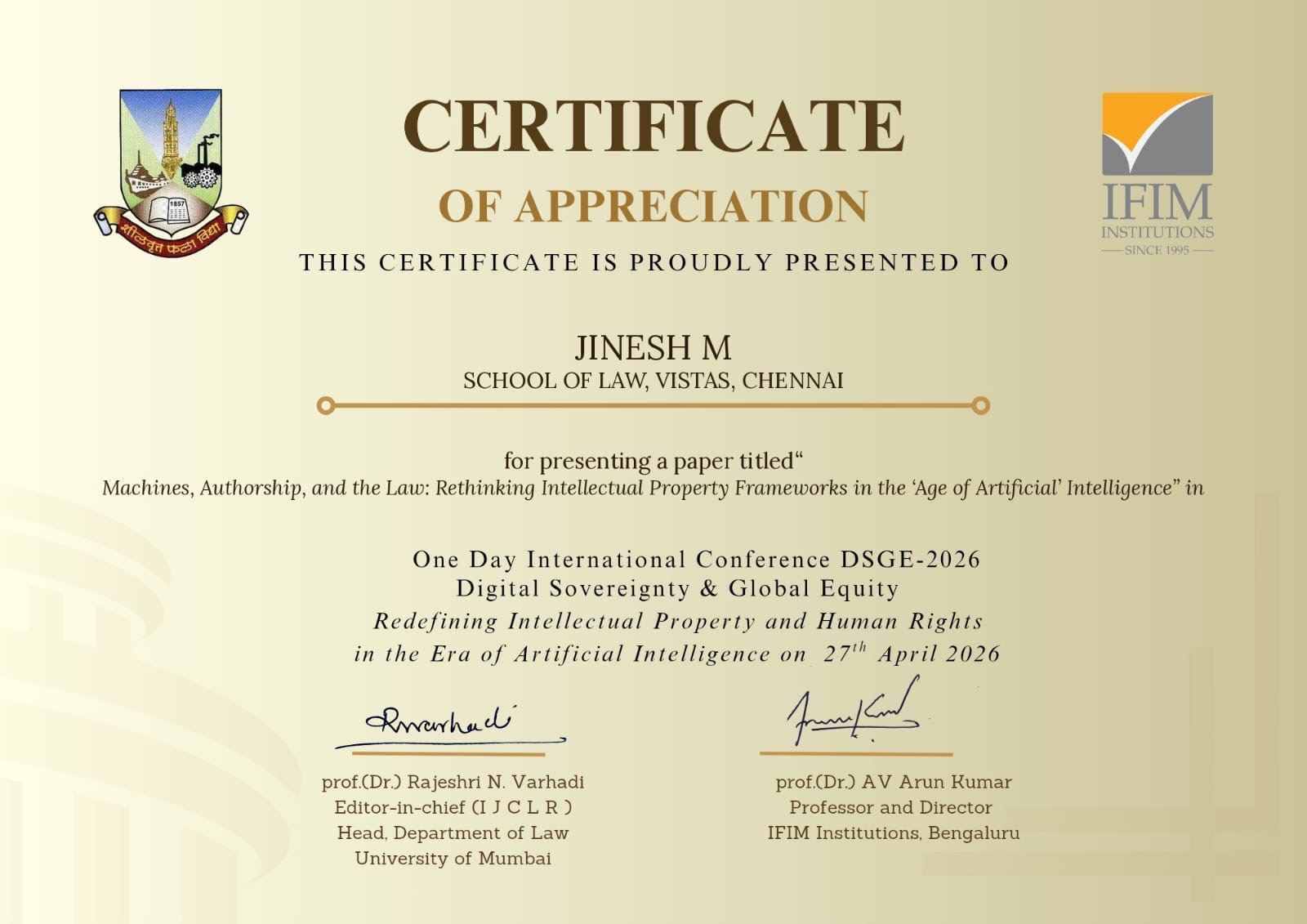
Jinesh, M (2026) Machines, Authorship, and the Law: Rethinking Intellectual Property Frameworks in the Age of Artificial Intelligence. In: One Day International Conference DSGE-2026 Digital Sovereignty & Global Equity Redefining Intellectual Property and Human Rights in the Era of Artificial Intelligence.
![[thumbnail of 1.JPG]](https://ir.vistas.ac.in/15691/1/1.JPG)
1.JPG
Download (151kB) | Preview
Abstract
The increasing popularity of artificial intelligence within creative and innovative areas has brought about a strong crisis in the way we conceptualize technology and intellectual property law. The existing methods of copyright and patents are founded on the notion that a human being created the work and here nothing can be patented as the work is a self-written novel or even a drug developed by machine. The paper delves into the emerging legal challenges related to generative AI systems and existing intellectual property laws aiming at answering key questions such as authorship, ownership, and how innovation can be effectively spurred. This paper argues that our legal directions are stretched to the farthest extent by looking at recent legal trends like the 2023 report by the United States Copyright Office on AI-assisted content, the decision of the Federal Circuit in Thaler v. Vidal on AI inventorship and its denial to grant an application to DABUS. These judges and regulators actions are discussed in the wider context of the incentives-driven and author-rights conception of the definition of intellectual property, and the argument that the two categories of approaches can never attempt to provide a sufficient explanation of the uniqueness of the creativity that is introduced by AI. The paper further examines some of the suggested legislative and policy solutions, which include the introduction of a unique sui generis right of output animation generated by AI, the compulsory licensing system, and the rights of ownership of the person who implements or develops AI technologies. It concludes by saying that an all-round regulatory response must not only entail some adjustments to the current doctrines but also involve a reconsideration of what the intellectual property law is supposed to do in this era of non-human intelligence. Since AI spans international boundaries, international consistency will become a vital goal to prevent a set of regulations.
| Item Type: | Conference or Workshop Item (Paper) |
|---|---|
| Subjects: | Legal Studies > Information Technology Law |
| Domains: | Legal Studies |
| Depositing User: | IR Admin |
| Date Deposited: | 11 May 2026 04:42 |
| Last Modified: | 19 May 2026 16:07 |
| URI: | https://ir.vistas.ac.in/id/eprint/15691 |
Actions (login required)

- View Item