
Artificial intelligence for detecting misappropriation of marine traditional knowledge in genomic databases under the BBNJ framework
Tancy, Sebastian and Gayathri, A and Bhuvaneshwari, M and Bharathi, M and Thavitha Thulasi, P and Pooja Sudharma, B (2026) Artificial intelligence for detecting misappropriation of marine traditional knowledge in genomic databases under the BBNJ framework. Artificial intelligence for detecting misappropriation of marine traditional knowledge in genomic databases under the BBNJ framework: 1183. ISSN 1183
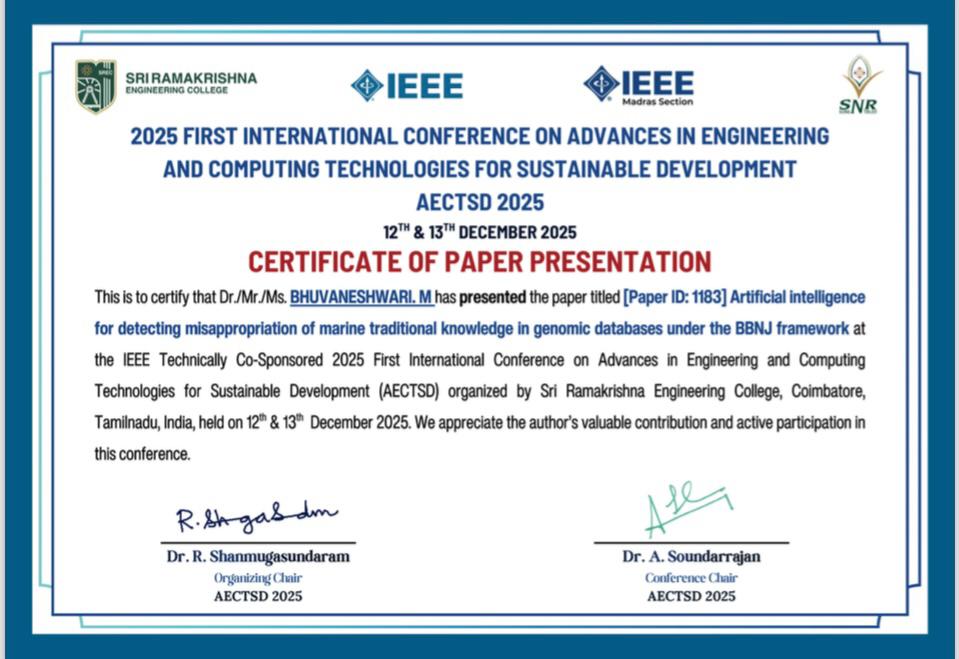
![[thumbnail of SCORPUS]](https://ir.vistas.ac.in/15583/1/SCORPUS%201.jpeg)

SCORPUS 1.jpeg - Other
Download (78kB) | Preview

Abstract
Abstract— The burgeoning growth of genomic studies has likewise augmented the exposure and accessibility of marine genetic sources (MGRs), but it has also amplified the danger of misuse of the traditional knowledge (TK) of Indigenous and local peoples (ILCs). Within the new Biodiversity Beyond National Jurisdiction (BBNJ) framework, to ensure equitable access and benefit-sharing (ABS), new methods are needed to track provenance and protect community rights. This paper will describe an artificial intelligence pipeline that can be used to identify possible misappropriation of marine TK in genomic databases. Structured and unstructured data, such as public genomic repositories, biodiversity occurrence datasets, ethnobiological registries, patents, permits, and ILC consent protocols, are combined together in data integration. Preprocessing forms a provenance graph model with provenance-rich graphs between samples, sequences, publications, collectors, permits, and communities. Multimodal AI algorithms are implemented: natural language transformers categorize language used in publications related to TK, DNA sequence models detect aberrant patterns, and graph neural networks predict suspicious provenance propagation. Ensemble classifiers combine these modalities to provide risk scores, and anomaly detectors identify metadata anomalies. Crossvalidation and temporal holdout evaluation has shown high performance considering high recall in legal risk detection. Its strength and ethical soundness are guaranteed by case studies, expert review, and adversarial stress tests. The framework adds a scalable, auditable marine TK protection tool and assists in meeting ABS requirements
| Item Type: | Article |
|---|---|
| Subjects: | Legal Studies > International Law |
| Domains: | Legal Studies |
| Depositing User: | Mr IR Admin |
| Date Deposited: | 11 May 2026 03:52 |
| Last Modified: | 21 Jul 2026 10:14 |
| URI: | https://ir.vistas.ac.in/id/eprint/15583 |
Actions (login required)

- View Item