
EMERGENCY POWERS IN THE POST-PANDEMIC ERA: CONSTITUTIONAL LIMITS ON EXECUTIVE AUTHORITY DURING HEALTH CRISES Analysing the Balance Between Public Health and Constitutional Rights Based on COVID-19 Precedents
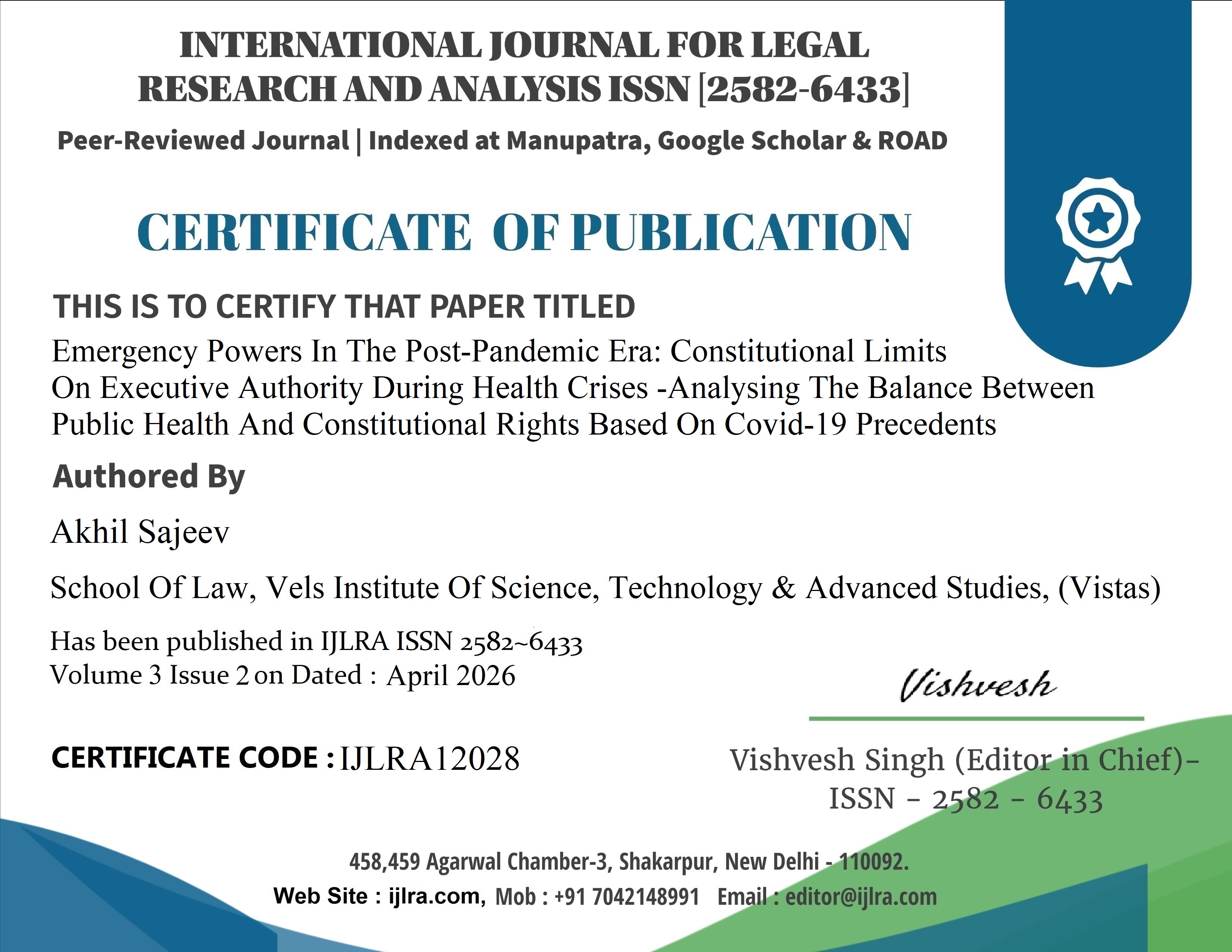
AKHIL, SAJEEV and RAJAGURU, C (2026) EMERGENCY POWERS IN THE POST-PANDEMIC ERA: CONSTITUTIONAL LIMITS ON EXECUTIVE AUTHORITY DURING HEALTH CRISES Analysing the Balance Between Public Health and Constitutional Rights Based on COVID-19 Precedents. INTERNATIONAL JOURNAL FOR LEGAL RESEARCH AND ANALYSIS, 3 (2): 15512. pp. 2099-2109. ISSN 2582-6433
![[thumbnail of Akhil Sajeev 4.jpg]](https://ir.vistas.ac.in/15512/1/Akhil%20Sajeev%204.jpg)
Akhil Sajeev 4.jpg - Published Version
Download (1MB) | Preview
Abstract
The COVID-19 pandemic marked an unprecedented global health crisis that
compelled governments to invoke extraordinary emergency powers to safeguard
public health. Across jurisdictions, executive authorities assumed expansive roles,
often bypassing or minimizing ordinary legislative processes to respond swiftly to
evolving threats. While such actions were widely justified on the grounds of
necessity and urgency, they simultaneously raised profound constitutional
questions regarding the limits of executive authority, the preservation of
fundamental rights, and the durability of democratic governance during
emergencies. This paper critically examines the use of emergency powers in the
post-pandemic era, focusing on how constitutional frameworks have been
interpreted, stretched, or, in some cases, challenged during health crises. It
explores the legal foundations that permit governments to declare emergencies,
impose restrictions such as lockdowns, quarantine mandates, and surveillance
measures, and regulate individual behavior in the interest of collective safety. By
analyzing judicial responses and constitutional doctrines, the study highlights the
tension between state responsibility to protect public health and the obligation to
uphold civil liberties, including freedom of movement, privacy, and personal
autonomy. A central concern addressed in this research is the risk of executive
overreach under the guise of emergency. The pandemic illustrated how prolonged
reliance on executive orders and delegated legislation can weaken institutional
checks and balances. In several instances, courts were called upon to determine
whether restrictions imposed were proportionate, necessary, and time-bound. The
principle of proportionality emerged as a crucial standard, requiring that any
limitation on rights must pursue a legitimate aim, be suitable to achieve that aim,
and represent the least restrictive means available. However, the application of this
6 principle varied across jurisdictions, reflecting differences in constitutional
culture, judicial activism, and political context. The study also evaluates how
emergency powers have evolved in the post-pandemic landscape. Even as the
immediate threat of COVID-19 has receded, many governments have retained or
normalized certain extraordinary measures, including expanded surveillance
capabilities and public health regulations. This raises concerns about the potential
institutionalization of emergency governance, where exceptional powers become
embedded in ordinary legal frameworks. Such developments necessitate a re-
examination of constitutional safeguards to prevent the erosion of democratic
accountability. Furthermore, this paper considers comparative perspectives,
drawing insights from multiple legal systems to understand how different countries
navigated the balance between public health imperatives and constitutional
protections. It underscores the importance of transparency, legislative oversight,
and judicial review in maintaining this balance. The role of courts as guardians of
constitutional rights is particularly emphasized, as they serve as a critical check on
executive excess while recognizing the need for deference in times of genuine
crisis. In addition, the research highlights the significance of temporal limitations
on emergency measures. Emergency powers are, by definition, intended to be
temporary; however, the pandemic demonstrated how easily such measures can be
extended without adequate scrutiny. Establishing clear sunset clauses, periodic
review mechanisms, and accountability frameworks is essential to ensure that
extraordinary powers do not outlive their necessity. The paper ultimately argues
that while emergency powers are indispensable tools for managing public health
crises, their exercise must remain firmly anchored within constitutional boundaries.
The post-pandemic era presents an opportunity to refine legal doctrines and
institutional practices to better prepare for future emergencies without
compromising democratic values. Strengthening legal safeguards, enhancing
institutional 7 resilience, and fostering a rights-conscious approach to governance
are critical to achieving this objective. In conclusion, the experience of COVID-19
serves as a cautionary tale and a learning opportunity. It demonstrates the delicate
balance between ensuring collective security and preserving individual freedoms.
By critically assessing the constitutional limits on executive authority during health
crises, this study contributes to the ongoing discourse on how democracies can
effectively respond to emergencies while remaining true to their foundational
principles.
Keywords: Emergency Powers, Executive Authority, Constitutional Law, COVID-
19, Public Health Law, Fundamental Rights, Judicial Review, Proportionality
Principle, Rule of Law, Democratic Governance, State of Emergency, Civil
Liberties, Health Crisis Regulation, Separation of Powers, Post-Pandemic Legal
Framework
| Item Type: | Article |
|---|---|
| Subjects: | Legal Studies > Constitutional Law |
| Domains: | Legal Studies |
| Depositing User: | Mr IR Admin |
| Date Deposited: | 12 May 2026 08:06 |
| Last Modified: | 12 May 2026 08:06 |
| URI: | https://ir.vistas.ac.in/id/eprint/15512 |
Actions (login required)

- View Item