
Climate Migrants life under threat: Analyzing Global Efforts dealing with Climate Migrants and Climate change(SDG13).
Sincy, Wilson and Amuthalakshmi, N (2025) Climate Migrants life under threat: Analyzing Global Efforts dealing with Climate Migrants and Climate change(SDG13). Education Research and Development Association (ERDA), Sponsored a “Two-Day International Conference on “Innovations and Challenges in Law, Management and Social Sciences, 1 (1): 9. pp. 105-120. ISSN ISBN: 978-93-6163-949-4
![[thumbnail of sincy saveetha.jpeg]](https://ir.vistas.ac.in/14764/1/sincy%20saveetha.jpeg) Image
Image
sincy saveetha.jpeg
Download (169kB)
Abstract
Abstract
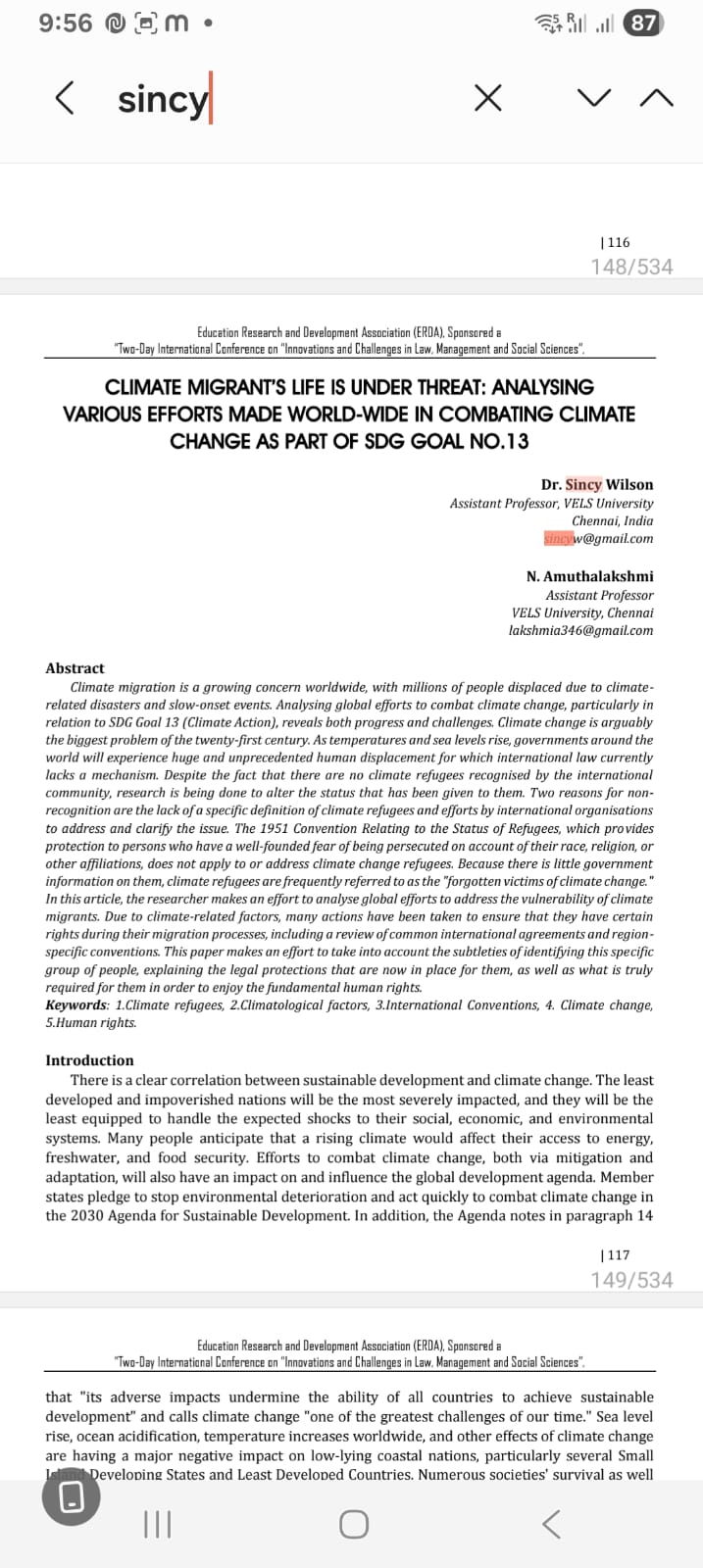
Climate migration is a growing concern worldwide, with millions of people displaced due to climate-related disasters and slow-onset events. Analyzing global efforts to combat climate change, particularly in relation to SDG Goal 13 (Climate Action), reveals both progress and challenges. Climate change is arguably the biggest problem of the twenty-first century. As temperatures and sea levels rise, governments around the world will experience huge and unprecedented human displacement for which international law currently lacks a mechanism. Despite the fact that there are no climate refugees recognised by the international community, research is being done to alter the status that has been given to them. Two reasons for non-recognition are the lack of a specific definition of climate refugees and efforts by international organisations to address and clarify the issue. The 1951 Convention Relating to the Status of Refugees, which provides protection to persons who have a well-founded fear of being persecuted on account of their race, religion, or other affiliations, does not apply to or address climate change refugees. Because there is little government information on them, climate refugees are frequently referred to as the "forgotten victims of climate change." In this article, the researcher makes an effort to analyse global efforts to address the vulnerability of climate migrants. Due to climate-related factors, many actions have been taken to ensure that they have certain rights during their migration processes, including a review of common international agreements and region-specific conventions. This paper makes an effort to take into account the subtleties of identifying this specific group of people, explaining the legal protections that are now in place for them, as well as what is truly required for them in order to enjoy the fundamental human rights.
| Item Type: | Article |
|---|---|
| Subjects: | Legal Studies > International Law Legal Studies > Environmental Law |
| Domains: | Legal Studies |
| Depositing User: | IR Admin |
| Date Deposited: | 12 May 2026 08:07 |
| Last Modified: | 03 Sep 2026 09:53 |
| URI: | https://ir.vistas.ac.in/id/eprint/14764 |
Actions (login required)

- View Item