
LEGAL AND TECHNOLOGICAL CHALLENGES IN ADDRESSING COPYRIGHT PIRACY ON GLOBAL OTT PLATFORMS
Macharla, ramadevi and swati, v (2026) LEGAL AND TECHNOLOGICAL CHALLENGES IN ADDRESSING COPYRIGHT PIRACY ON GLOBAL OTT PLATFORMS. TIJER INTERNATIONAL JOURNAL, 13 (24). pp. 1-19. ISSN 2349-9249
![[thumbnail of TIJER2604229.pdf]](https://ir.vistas.ac.in/style/images/fileicons/text.png) Text
Text
TIJER2604229.pdf
Download (474kB)
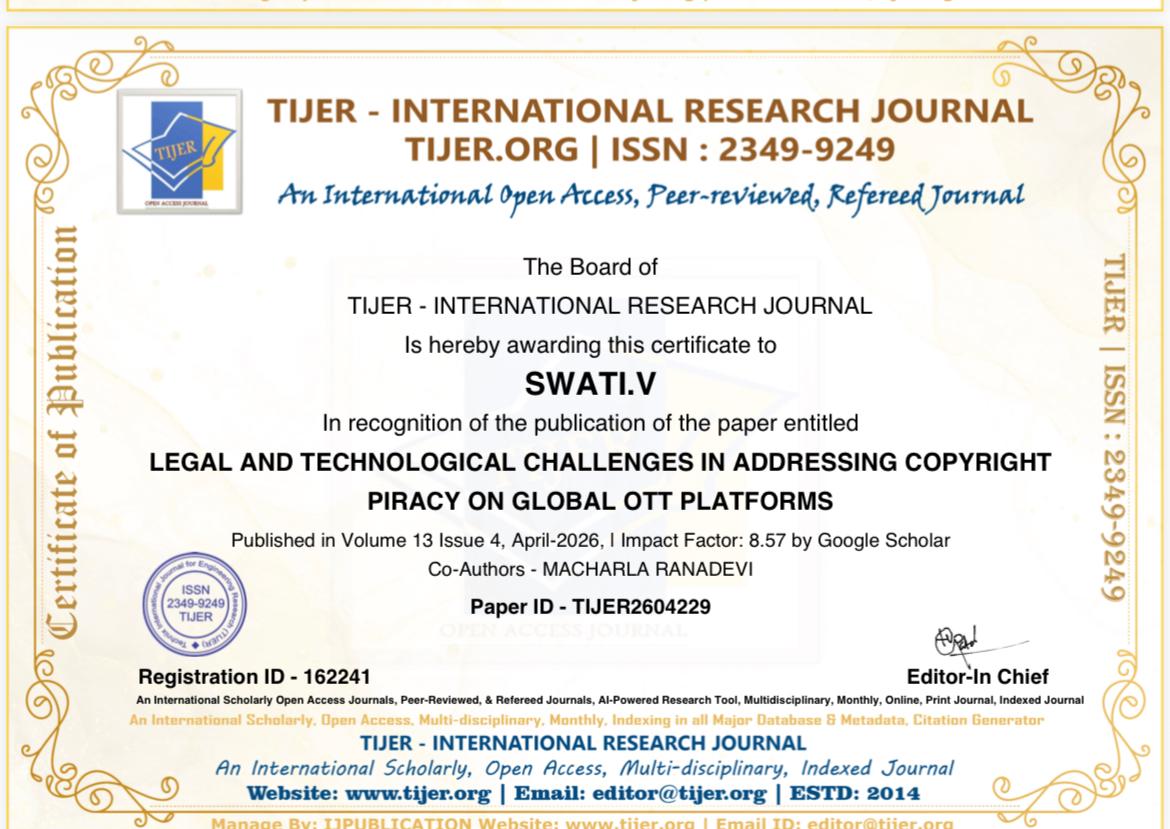
![[thumbnail of WhatsApp Image 2026-05-10 at 12.08.19 PM.jpeg]](https://ir.vistas.ac.in/14759/2/WhatsApp%20Image%202026-05-10%20at%2012.08.19%20PM.jpeg)

WhatsApp Image 2026-05-10 at 12.08.19 PM.jpeg
Download (125kB) | Preview

Abstract
The rapid expansion of Over-the-Top (OTT) streaming platforms has transformed the global entertainment ecosystem by enabling on-demand access to digital content across borders. However, this growth has simultaneously intensified the problem of copyright piracy, which remains one of the most persistent threats to the creative industries. This research examines the complex interplay between legal frameworks and technological mechanisms in combating copyright piracy on global OTT platforms, highlighting the limitations and gaps that persist despite ongoing regulatory and technical interventions. From a legal perspective, the transnational nature of OTT services creates jurisdictional challenges, as copyright laws vary significantly across countries.
While international agreements such as the Berne Convention and the TRIPS Agreement attempt to harmonize protection standards, enforcement remains fragmented and inconsistent. OTT platforms often operate across multiple legal regimes, making it difficult to identify applicable law and hold infringers accountable. Additionally, safe harbor provisions protecting intermediaries frequently limit platform liability, further complicating enforcement against piracy networks that exploit digital ecosystems. On the technological front, OTT providers employ a range of anti-piracy tools, including digital rights management (DRM), watermarking, encryption protocols, and artificial intelligence-based monitoring systems. Despite these advancements, piracy continues to evolve through techniques such as screen recording, credential sharing, illegal streaming websites, and decentralized peer-to-peer networks. The adaptability of piracy technologies often outpaces preventive mechanisms, exposing the reactive rather than proactive nature of current solutions. The study further explores how socio-economic factors, accessibility issues, and consumer behavior contribute to the persistence of piracy. In many regions, high subscription costs and limited content availability encourage users to resort to unauthorized sources. Thus, piracy cannot be addressed solely through enforcement; it requires a balanced approach that integrates affordability, accessibility, and user awareness.
This research concludes that effective mitigation of OTT piracy requires a hybrid strategy combining stronger international legal harmonization with advanced adaptive technologies and consumer-centric policies. A coordinated global response is essential to protect intellectual property rights while ensuring equitable access to digital content.Keywords : OTT Platforms; Copyright Piracy; Digital Rights Management; International Copyright Law; Streaming Services; Cyber Enforcement
| Item Type: | Article |
|---|---|
| Subjects: | Legal Studies > Intellectual Property |
| Domains: | Legal Studies |
| Depositing User: | Mr IR Admin |
| Date Deposited: | 10 May 2026 06:47 |
| Last Modified: | 19 May 2026 08:40 |
| URI: | https://ir.vistas.ac.in/id/eprint/14759 |
Actions (login required)

- View Item