
Zero-Trust Architectures for Cloud-Native Systems: A Secure-by-Design Approach to Modern Cyber Defense
S, Jayashree and Thirumalaikumari, T. and Bagavathi Lakshmi, R and Narayani., D. (2026) Zero-Trust Architectures for Cloud-Native Systems: A Secure-by-Design Approach to Modern Cyber Defense. In: Quantum Computing and Emerging Computational Paradigms. Stanzaleaf Publication, , Namakkal, Tamil Nadu, India., pp. 24-33. ISBN 978-81-999655-9-1
![[thumbnail of BOOK CHAPTER-QUANTUM COMPUTING AND EMERGING COMPUTATIONAL]](https://ir.vistas.ac.in/style/images/fileicons/text.png) Text (BOOK CHAPTER-QUANTUM COMPUTING AND EMERGING COMPUTATIONAL)
Text (BOOK CHAPTER-QUANTUM COMPUTING AND EMERGING COMPUTATIONAL)
ACFrOgCEWW9nScTcmhXJ32GPSJqp7abrQuyGvq0s8QusWqKLEU3atjpj5mBfq6zbTMC8puyQSxgk5Wnv8q7ZgLbjv1vwRqm_2yCDZN_tic6DOekdpNX0cc4OxDrFM2pzVzNG1K5LKFgJ8FRb_rfTVxVRFmva3zfRtsGFDFUWaw==.pdf
Download (193kB)
![[thumbnail of Zero-Trust Architectures for Cloud-Native Systems: A Secure-by-Design Approach to Modern Cyber Defense]](https://ir.vistas.ac.in/14677/2/IMG-20260408-WA0088.jpg)
IMG-20260408-WA0088.jpg
Download (143kB) | Preview
Abstract
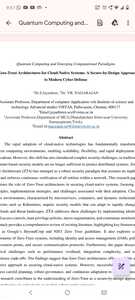
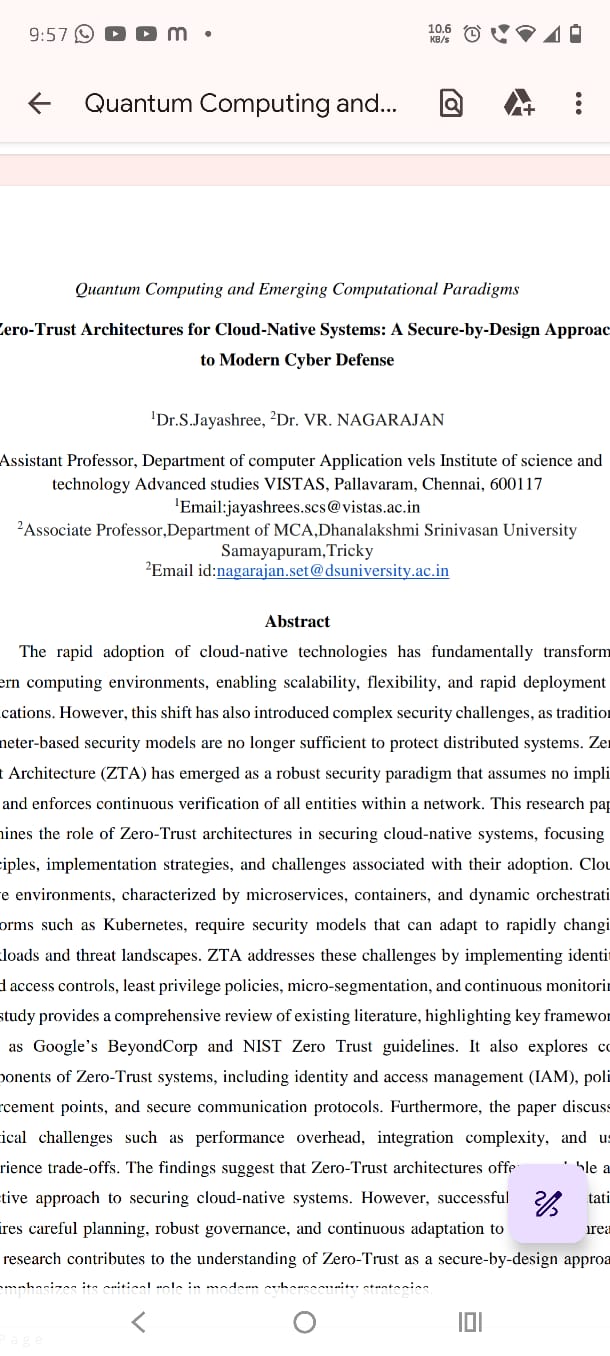
The rapid adoption of cloud-native technologies has fundamentally transformed modern computing environments, enabling scalability, flexibility, and rapid deployment of applications. However, this shift has also introduced complex security challenges, as traditional perimeter-based security models are no longer sufficient to protect distributed systems. Zero-Trust Architecture (ZTA) has emerged as a robust security paradigm that assumes no implicit trust and enforces continuous verification of all entities within a network. This research paper examines the role of Zero-Trust architectures in securing cloud-native systems, focusing on principles, implementation strategies, and challenges associated with their adoption. Cloud-native environments, characterized by microservices, containers, and dynamic orchestration platforms such as Kubernetes, require security models that can adapt to rapidly changing workloads and threat landscapes. ZTA addresses these challenges by implementing identity-based access controls, least privilege policies, micro-segmentation, and continuous monitoring.
The study provides a comprehensive review of existing literature, highlighting key frameworks such as Google’s BeyondCorp and NIST Zero Trust guidelines. It also explores core components of Zero-Trust systems, including identity and access management (IAM), policy enforcement points, and secure communication protocols. Furthermore, the paper discusses practical challenges such as performance overhead, integration complexity, and user experience trade-offs. The findings suggest that Zero-Trust architectures offer a scalable and effective approach to securing cloud-native systems. However, successful implementation requires careful planning, robust governance, and continuous adaptation to evolving threats. This research contributes to the understanding of Zero-Trust as a secure-by-design approach and emphasizes its critical role in modern cybersecurity strategies.
| Item Type: | Book Section |
|---|---|
| Subjects: | Computer Science Engineering > Computer System Architecture Computer Science Engineering > Cloud Computing |
| Domains: | Computer Science |
| Depositing User: | IR Admin |
| Date Deposited: | 10 May 2026 11:47 |
| Last Modified: | 01 Sep 2026 04:49 |
| URI: | https://ir.vistas.ac.in/id/eprint/14677 |
Actions (login required)

- View Item